
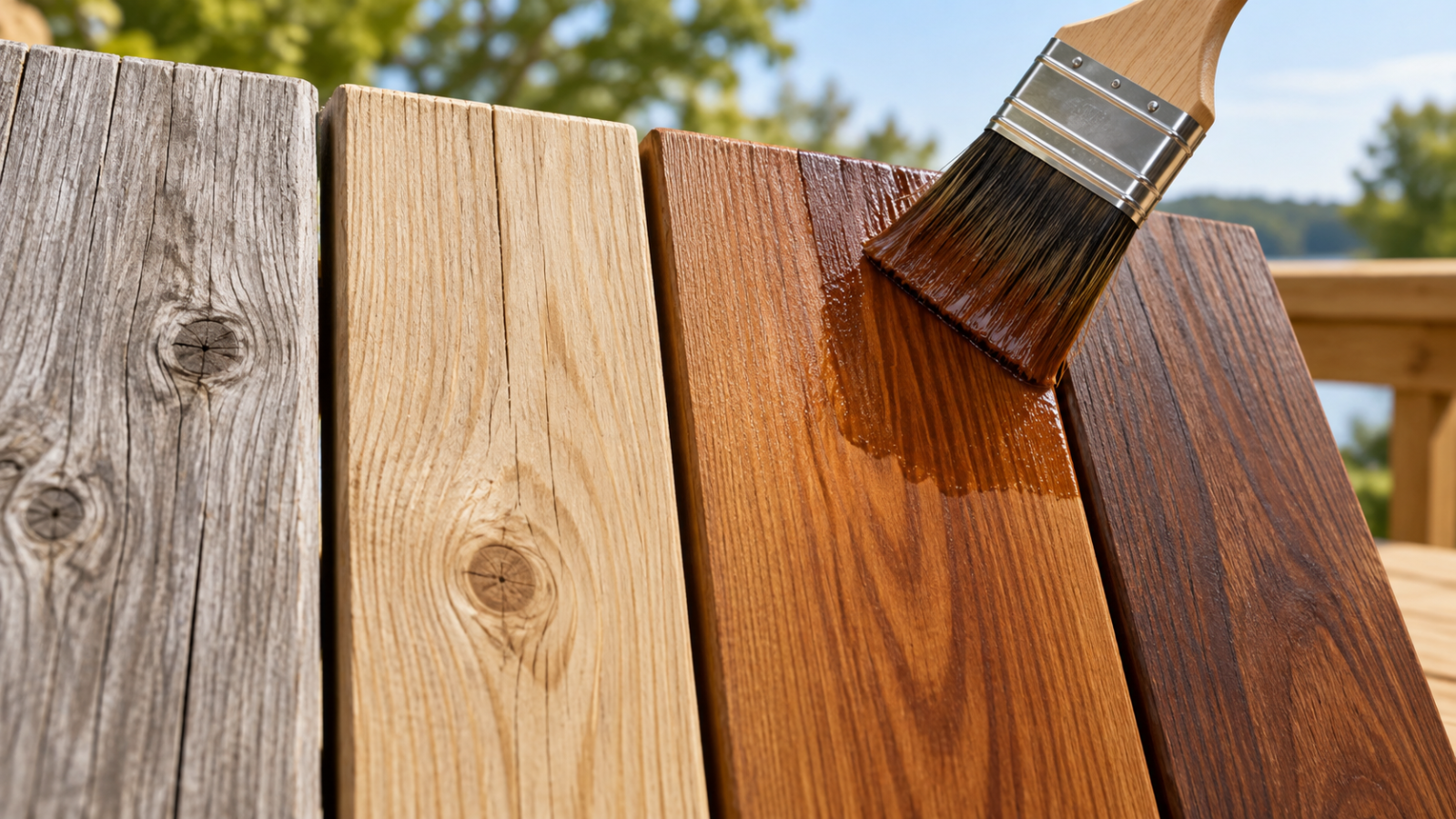
Choosing an exterior wood stain is where most deck and fence projects go wrong, usually before the can is even opened. Stain aisles are organized around color, but color is the last thing that should drive the decision. Buy in this order instead: wood species first, the condition of the wood second, how the finish behaves in the wood third, and color last. Species and condition rule out the wrong products faster than anything else, and getting either one wrong is what produces a peeling deck 18 months after a weekend of work.
At Woodrich Brand, we have been selling exterior wood finishes online since 1998. Russell Cissell developed the line on his own job sites in the 1990s, when the commercial products of the day kept failing him, and he has spent more than 30 years restoring cedar homes and decks around St. Louis. Calls to our Project Support Hotline rarely start with color. They start with a finish that failed, and the failure usually traces back to a product that was never compatible with that wood or that surface.
This guide covers exterior wood only: decks, fences, siding, log homes, pergolas, docks, and outdoor furniture. Interior stain, gel stain, and polyurethane topcoat systems follow different rules and are outside what we cover here.
The Right Order to Choose a Wood Stain
Most stain aisles and buying guides are organized around color and opacity, because that is the part people care about. It is also the part that rules out the fewest wrong products.
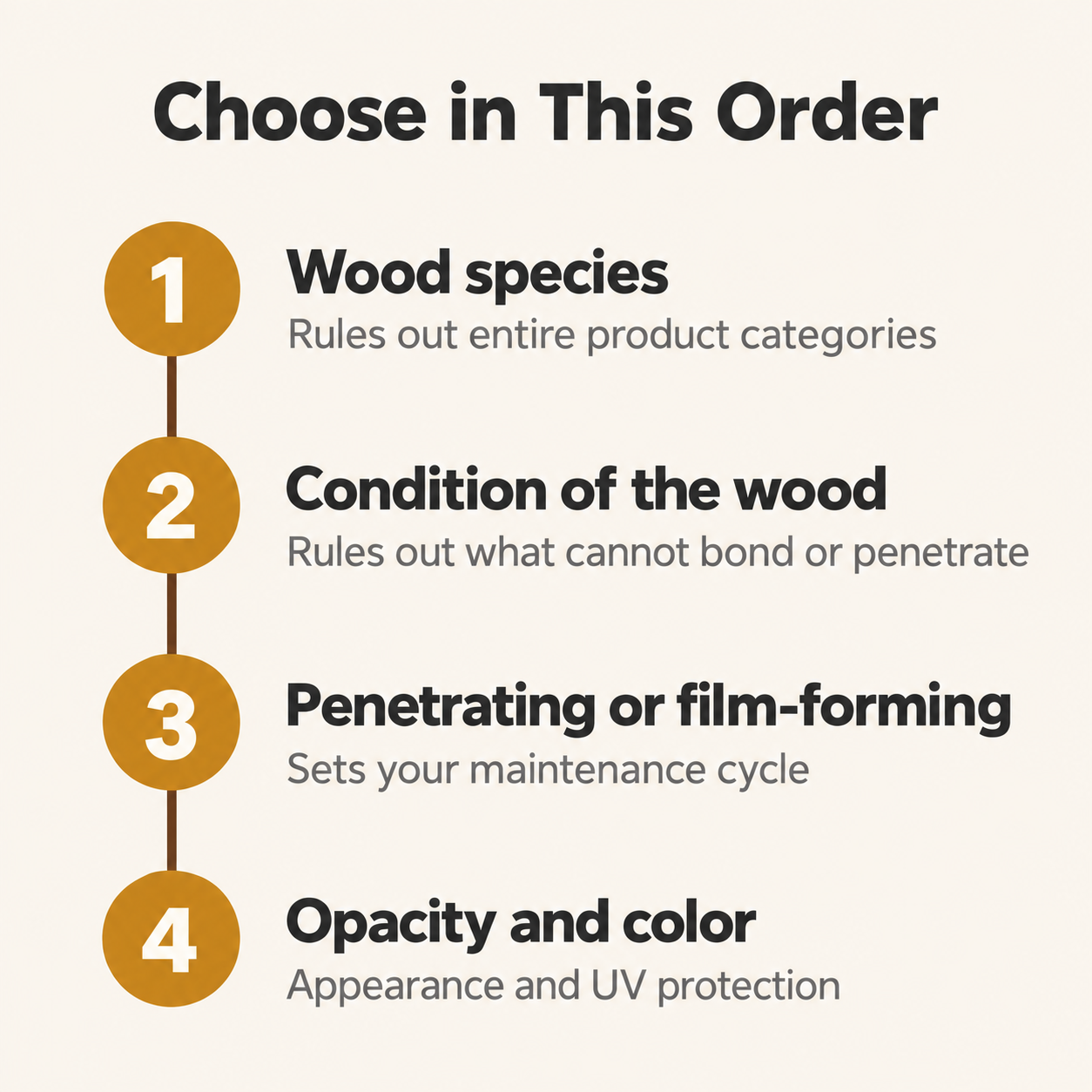
- Wood species. Rules out entire product categories. It comes first because a finish built for cedar will fail early on ipe, and the reverse is also true.
- Current condition. Rules out products that cannot bond or penetrate. Gray or weathered wood is ready for a penetrating stain after cleaning, but a cracking or peeling film has to be stripped off before anything will bond or penetrate.
- Penetrating or film-forming. Rules out products with the wrong maintenance cycle. This decides whether the next refresh is a cleaning or a full strip.
- Opacity and color. Rules out nothing structural. By this point compatibility is settled, so this is purely a UV and appearance call.
Work in the order above, and by the time you reach color you are choosing between four or five products instead of forty.
Step 1: Identify Your Wood Species
Wood is not a neutral surface that a finish sits on top of, which is why species comes first. The USDA Forest Products Laboratory treats density, grain orientation, extractives, and surface texture as part of finish performance itself. Its service life estimates for the same coating vary by roughly double depending on what is underneath. Semitransparent stain on smooth cedar or redwood siding is estimated at 2 to 4 years. The same product class on saw-textured cedar or redwood siding runs 4 to 8 years, according to the Wood Handbook, Chapter 16.
Softwoods: Cedar, Pressure-Treated Pine, Cypress, Redwood
These species accept a penetrating oil well. The grain is open enough that the finish moves into the surface pores and cell lumens instead of sitting on top. Most decks, fences, and wood siding in the United States fall into this category.
Our Timber Oil Deep Penetrating Wood Stain is built for this group. It covers 150 square feet per gallon and goes on new wood, or on weathered wood that has been cleaned and brightened first.
One species-specific warning. Cedar and redwood heartwood carry colored, water-soluble extractives that can migrate to the surface and leave yellow to reddish-brown discoloration under a film-forming coating. Those same tannins react with iron to produce blue-black staining, which is why steel wool and ordinary steel wire brushes should not be used on a cedar deck.
Dense Tropical Hardwoods: Ipe, Teak, Mahogany, Cambara, Garapa
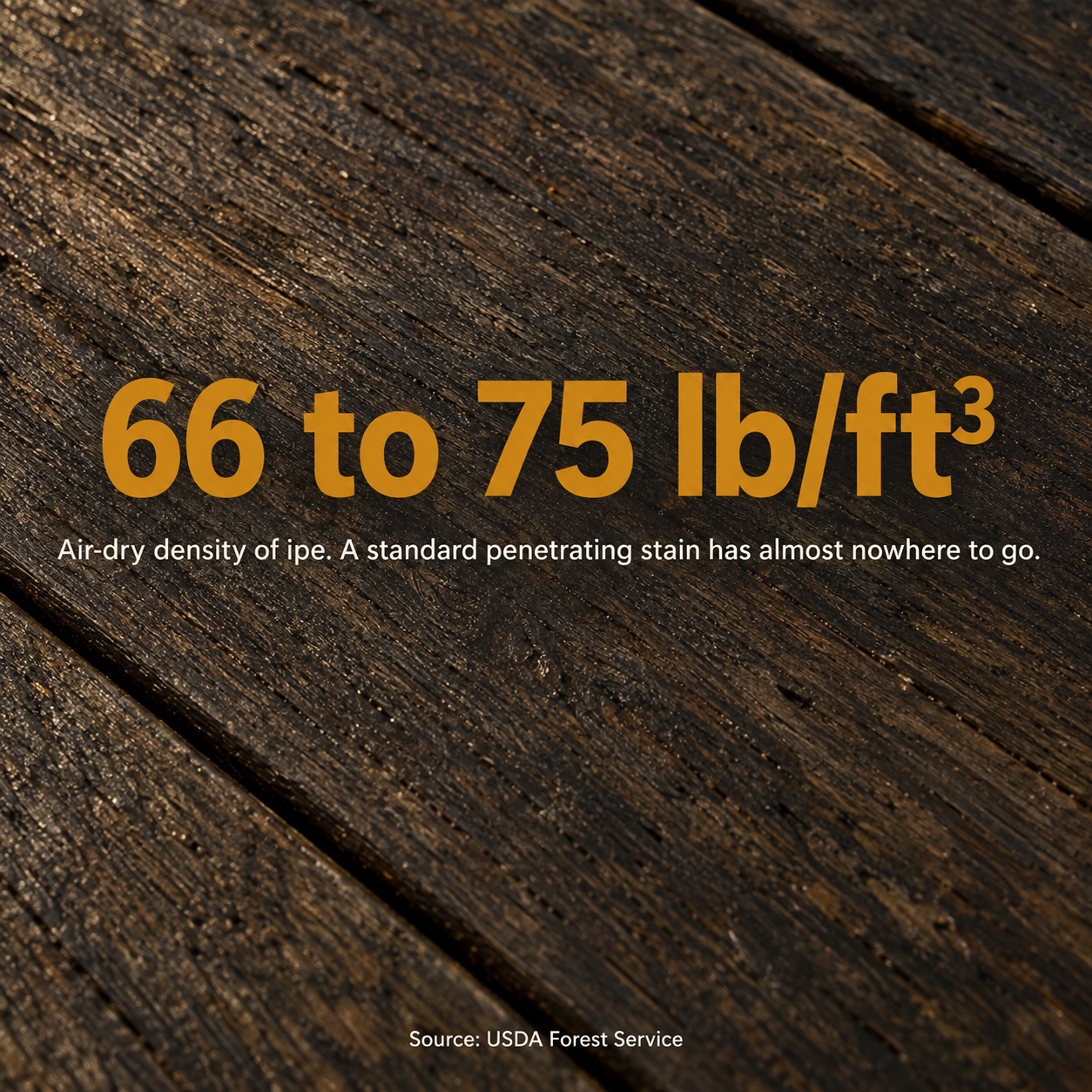
These woods are a separate category. Ipe has a basic specific gravity of 0.85 to 0.97 and an air-dry density of 66 to 75 pounds per cubic foot, and USDA rates it as extremely resistant to preservative treatment, so very little liquid penetrates it regardless of what a label claims. Teak adds a second problem, because its heartwood contains biologically active extractives that interfere with ordinary finishes.
On these dense woods, a standard penetrating stain has almost nowhere to soak in, so it sits on the surface and fails early. The stain is fine. It just has nowhere to soak into on wood this dense.
Our Hardwood Wiping Stain is formulated for these woods. It uses micro-ground trans-oxide pigments locked by long oil alkyd resins, so it performs with the limited penetration these species allow. It covers 300 square feet per gallon and goes on differently: brush, roll, or spray it, then wipe the excess off with a dry rag.
Trade names complicate this. “Tigerwood” is used inconsistently across the decking market, and USDA’s own species index applies the name to a different wood than the North American decking trade usually does. Cumaru, garapa, and cambara are also sold under overlapping names. Identify the actual wood before you buy anything.
If You Cannot Tell What You Have
Text a photo of the wood to our Project Support Hotline at (636) 288-8512. Someone who has been identifying deck species for three decades will tell you what it is and which product line applies. For a longer breakdown by species, see how to choose deck stain for your wood type.
Step 2: Check the Condition of the Wood
Condition is the second gate, and it can eliminate a whole product category on its own. USDA is direct about the mechanism. A penetrating stain has to actually penetrate, and wherever an old finish remains as an intact film, the new product cannot get in. Film-forming finishes have the opposite problem, because they do not bond reliably to weathered, UV-degraded surface fibers.
Every exterior wood surface falls into one of three conditions.
Gray, unfinished wood. No finish left, either because it was never finished or because an old finish has worn all the way off and the wood has gone gray. Prep is a cleaner plus a brightener, and once it is clean nothing is ruled out.
Weathered oil-based stain. Chalky and dull, fading evenly with no flaking; bare gray wood may show in high-traffic or sunny spots. Prep is a cleaner plus a brightener, and once it is clean nothing is ruled out.
Cracking or peeling film. Flaking, lifting at board edges, shiny in patches. Prep is a heavy-duty stripping product plus a brightener, and until that film is gone every penetrating stain is ruled out.
The first two conditions lead to the same place: clean, brighten, and apply a penetrating stain. The third is the one that changes the job, and the one that most often adds cost you did not plan for. A semi-transparent finish cannot go over an existing solid stain, and no amount of cleaning changes that. The solid stain’s pigment has bonded to the wood surface as a barrier layer, so a penetrating product applied over it goes on blotchy, sits on top, and fails early. That film has to come off first.
One note on older pressure-treated wood. CCA-treated lumber was widely used for residential decks and playsets until manufacturers voluntarily stopped producing it for consumer uses in December 2003. The EPA does not ask homeowners to tear those structures out. It states that regularly applying a penetrating protective coating such as an oil- or water-based stain may reduce chemical leaching. If your deck predates 2004, the coating is doing more than improving appearance.
Step 3: Penetrating vs. Film-Forming Stain
This is the part most buying guides skip, and it sets what your maintenance looks like for the next decade.
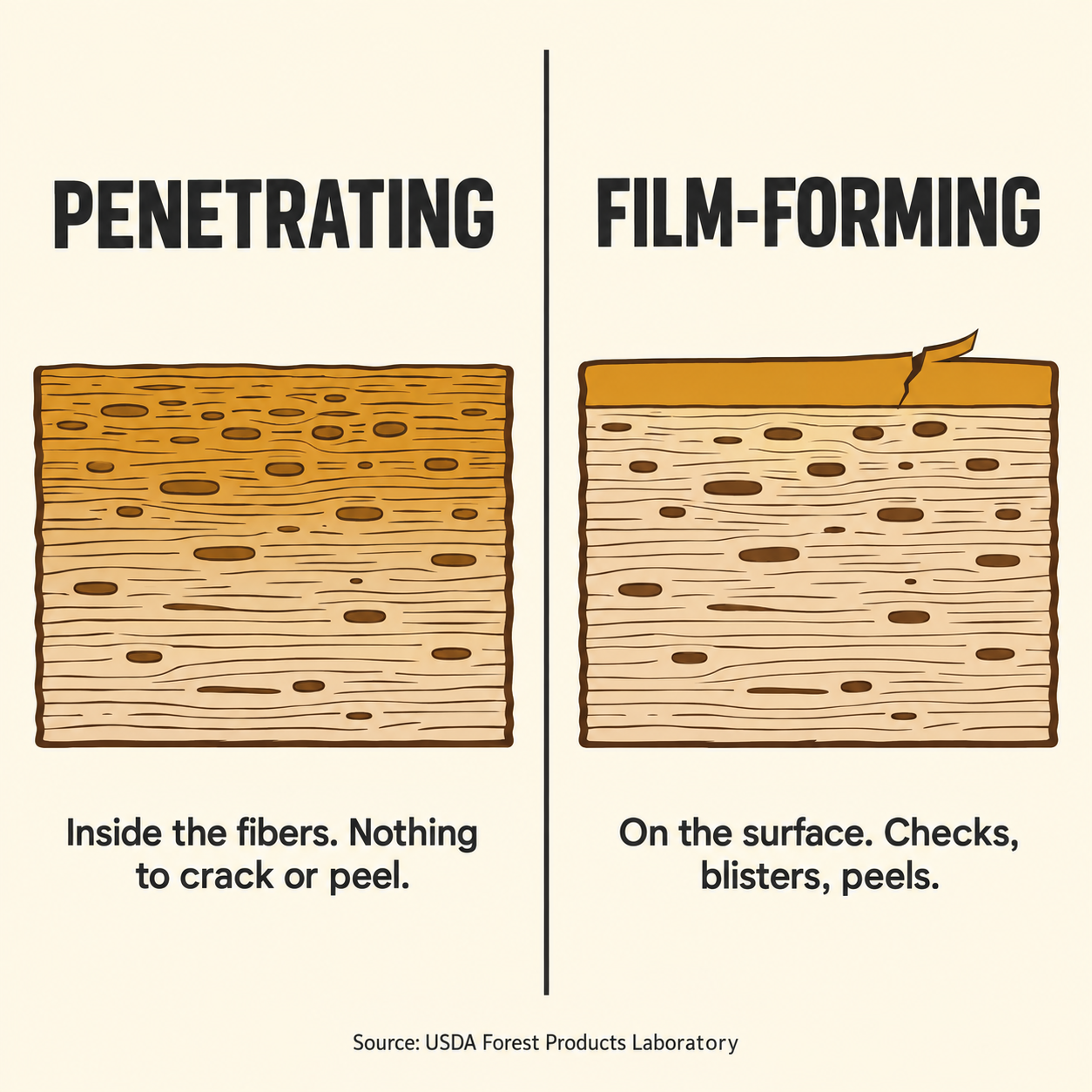
Finishes do one of two things. A penetrating finish flows into the surface pores and cell lumens without leaving a continuous membrane, so there is no film that could crack or flake. As it wears out, it sheds pigment gradually and grays.
A film-forming finish leaves a continuous binder layer across the surface. The wood underneath keeps absorbing and releasing moisture and keeps changing dimension, which puts stress on the coating. Eventually it checks, blisters, and peels.
| Penetrating finish | Film-forming finish | |
|---|---|---|
| How it sits | Inside the wood fibers | On the surface as a continuous layer |
| How it fails | Fades, grays, loses water repellency | Cracks, blisters, flakes, peels |
| What the next cycle costs | Clean and reapply | Strip, sometimes sand, then recoat |
| Horizontal deck suitability | High | Low, per USDA |
| Best fit | Decks, docks, railings, fences, most siding | Sound, stable vertical siding |
The Forest Products Lab calls the practical difference between the two “dramatic,” and it shows up when the finish reaches the end of its life.
Film-forming finishes are not defective. On sound, well-prepared, dimensionally stable vertical siding, a film can deliver far longer service. USDA estimates up to 15 to 20 years for paint on saw-textured cedar or redwood siding against 4 to 8 years for semitransparent stain. If your priority is the longest possible interval between repaints on a wall, that is a rational choice, as long as you accept the heavier prep bill when it finally comes off.
Horizontal surfaces are where the difference matters most. USDA specifically calls penetrating finishes an excellent choice for decks and railings, because standing moisture makes films difficult to hold and because films usually do not last long enough on a deck to earn back their harder maintenance. A long-term Oregon deck trial of 32 mostly penetrating finishes concluded that 2 to 3 years should be considered excellent for low-solids transparent systems in fully exposed horizontal service.
Oil vs. Water Is a Rough Proxy
People often shop by oil versus water, so it is worth being precise about what that distinction does and does not tell you. Both water-borne and solvent-borne penetrating formulations exist. Modern waterborne semi-transparent stains often get their appearance from a thin film, which means they can peel. An oil-based semi-transparent product can also form a film if it is overapplied. In a 2020 Forest Products Laboratory study of 12 commercial exterior coatings, only five meaningfully repelled water, and the best performer against mold and decay in that test was a transparent water-based alkyd acrylic. Carrier alone did not predict performance. The EPA takes the same position when it lists both oil- and water-based stains as examples of a penetrating protective coating.
The rule that oil usually penetrates and waterborne often films is directionally useful and historically accurate, but it is not reliable enough to buy on. Timber Oil is 100% oil-based with no water in it, and it penetrates. What matters here is the penetration, more than whether the carrier is oil or water.
The Visual Test for What You Already Have
You do not need a lab to sort your existing finish.
- Chalky, dull, wearing away evenly with no flaking: it behaved as a
penetrating finish. Clean and reapply.
- Flaking, peeling, or still shiny in patches: treat it as a
film-forming finish regardless of what the original label said.
Some products marketed as oil stains behave like films when it comes to removal, usually because they were high in solids or applied too heavily. How the finish behaves matters more than what the label says. If a supposedly penetrating stain dried shiny and smoothed over the wood texture, it crossed into film territory and will need to come off the way a film does. We go deeper on this in 3 types of oil-based exterior stains and sealers.
Step 4: Stain Opacity and Color
Color is the last decision, and one piece of physics shapes it. Pigment is what blocks ultraviolet light. Almost all pigments block UV, and more pigment generally means more protection for the wood and for the finish itself. A clear finish does less UV work than a pigmented one.
| Opacity | Grain visibility | UV protection and typical vertical service life (USDA) |
|---|---|---|
| Clear water-repellent | Full | Minimal; 1 to 3 years |
| Toner or lightly tinted | Full | Limited; 2 to 3 years |
| Semi-transparent | Grain and texture show, color evened out | Good; 4 to 8 years on saw-textured or weathered wood |
| Semi-solid | Texture shows, grain mostly hidden | Very good; between semi-transparent and solid |
| Solid | Hidden | Highest; 6 to 15 years, film-forming |
Two things the table does not make explicit. First, “clear” and “penetrating” are independent axes. There are clear film-forming coatings built on alkyd, acrylic, and polyurethane resins, and the best of them can approach 10 years under full exposure. That is a different product class from a clear penetrating deck sealer, and it carries film maintenance with it. Second, more opacity is not a straight ladder to better. On horizontal decking, USDA rates film-forming solid stain and paint as low suitability, so the most UV-protective option on the chart is also the wrong one for the surface most people are staining.
We make five pigmented Timber Oil colors (Warm Honey Gold, Brown Sugar, Amaretto, Western Cedar, and Signature Brown) plus Clear Advantage, and they can be mixed with each other for custom tones. We do not make a solid-color stain, and that is deliberate.
Solid stain does one thing better than anything else: it hides wood that is past the point of looking good. But it is film-forming by definition, and our entire line is built to penetrate. A lot of our business comes from people removing a failed solid stain, so for most of the projects that reach us, it is the right tool for the wrong job.
If color is where you are stuck, understanding wood stain colors and deck stain finishes explained go further than we can here.
How Much Stain to Buy
Coverage math is simple. Measure length and width, multiply for square footage, then divide by the product’s coverage rate.
- Timber Oil: 150 square feet per gallon
- Hardwood Wiping Stain: 300 square feet per gallon
A 16 by 20 foot cedar deck is 320 square feet. Divided by 150, that is roughly 2.2 gallons of Timber Oil for the deck surface alone. Railings, balusters, stair stringers, and skirting can easily add another 30% to 50% depending on the design, so a deck like that usually lands closer to a 5-gallon pail at 750 square feet than to three single gallons.
Buy on the generous side, because coverage is not constant across one structure. Weathered and saw-textured wood absorbs substantially more than smooth new wood, and protected areas with residual finish absorb very little. Purdue Cooperative Extension’s legacy benchmark for penetrating oil stain puts smooth surfaces at roughly 300 to 400 square feet per gallon and rough surfaces at 150 to 250, close to a twofold spread on the same product. Those figures are an estimating range rather than a modern specification, but the direction is real. It is why a weathered deck can take a second application where a new one takes only the first.
With Timber Oil, the target is saturation depth. Put down a heavy layer, let the wood absorb what it can, and when the surface stops absorbing and oil starts sitting on top, back-brush or wipe the excess away. A tacky finish after drying means too much was left on the surface, not that the wood needed more.
Budgeting for Prep: Cleaner, Stripping Product, and Brightener
Budget for prep at the same time as the stain. Prep changes the cost, the schedule, and sometimes the product choice itself.
Cleaning, stripping, and brightening solve three different problems.
| Product | Job | When you need it |
|---|---|---|
| EFC-38 Wood Cleaner | Removes dead gray fibers, mold, mildew, dirt, and lighter oil-based finishes | Bare gray wood, or a weathered penetrating finish |
| HD-80 | Removes solid stains, heavy films, polyurethane, varnish, and paint | Any cracking, peeling, or still-shiny film |
| Citralic Brightener | Neutralizes pH after cleaning or stripping and restores fresh-cut tone | After either of the above, before staining |
Most deck cleaners on the shelf are bleach and water. They lighten the gray out of dead wood fibers and leave those fibers sitting on the surface, where they interfere with how the wood takes stain. Our cleaners are formulated to release the lignin binding those dead fibers so they can be rinsed away entirely.
Brightening is the step people skip, and after a strong alkaline stripping product it is not optional. USDA is explicit that strong alkali can pulp and chemically damage wood, that the surface should be neutralized with a mild acid afterward, and that residual alkali degrades both the wood and the coating that goes over it. Citralic is citric acid based, mixes at about two-thirds cup per gallon, dwells 5 minutes or more, and covers 3,000 square feet from a 10-pound pail.
Two more prep costs are worth planning for.
Dry time. USDA guidance sets 20% moisture content as a general upper limit for finishing exterior wood, and typical exterior equilibrium values run much lower: around 12% to 14% across much of the country, near 16% in the Pacific Northwest, and 6% to 9% in the Southwest, per Oregon State University Extension. We recommend letting the wood get below 12% before staining, which usually means 24 to 48 hours of dry weather after brightening.
Restraint. Over-cleaning is a real failure mode. High-pressure washing preferentially erodes softer earlywood and leaves ridged latewood behind, and aggressive chemicals can pulp the surface. Clean enough to get a sound, uniform substrate. Stripping to raw bright wood every time is not the goal.
To buy the whole sequence matched to your square footage, our restoration kits pair the cleaner, brightener, and stain in matched quantities. There is more detail on the cleaning question in do I need a deck cleaner before staining.
When to Apply Wood Stain: Temperature and Timing
Stain has a weather window, and missing it costs you the application.
- Timber Oil: above 40°F, and above freezing at minimum
- Hardwood Wiping Stain: above 60°F
USDA recommends brushing penetrating finishes into the wood and working in the shade where possible, because fast drying shortens working time and drives lap marks. It also advises against applying finish to hot surfaces in direct sun.
Russell’s rule of thumb is simpler than a thermometer: if you cannot hold your hand flat on the wood, it is too hot to stain. Hot wood dries the finish before it can move into the fibers. Early morning, late afternoon, and overcast days are the good windows.

At 70°F or above, Timber Oil is walkable in about 2 hours and dries in 2 to 3 days. Cleanup is mineral spirits.
How Often to Reapply Wood Stain
Do not plan around a single number. Reapplication timing depends on orientation, sun exposure, and surface texture more than on the calendar.
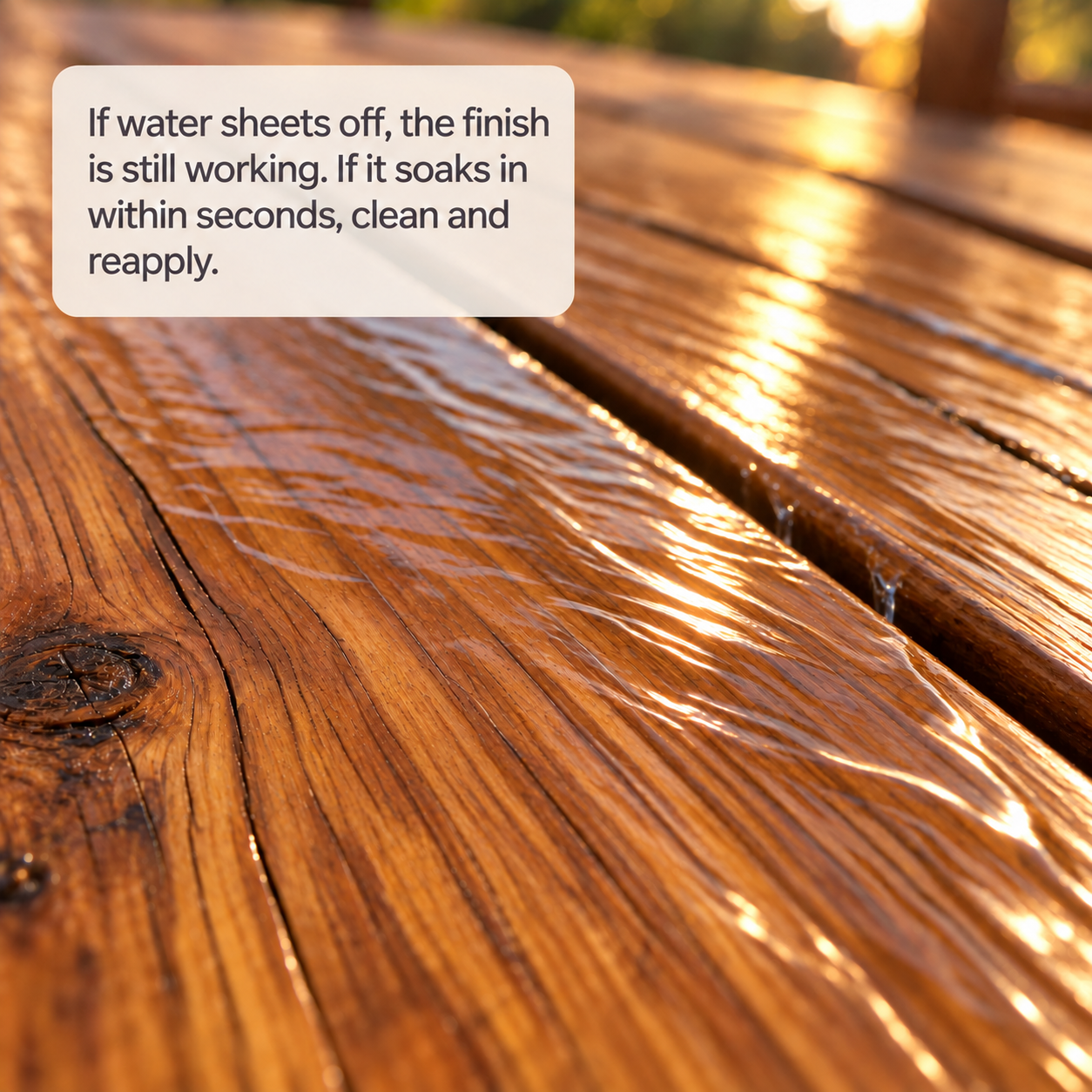
The trigger is the water bead test. Pour a little water on the surface. If it beads and runs off, the finish is still working. If it soaks in within a few seconds, the wood is losing protection and it is time to clean and reapply. Fading color, a chalky look, and dry or graying grain are the visual confirmations.
The Woodrich figures below come from our own field observation rather than published testing, so treat them as ours rather than an industry standard.
| Surface and exposure | What we see with Timber Oil | USDA estimate, semitransparent stain |
|---|---|---|
| Horizontal deck, full sun | About 2 years | 2 to 3 years new smooth, 3 to 6 years weathered or saw-textured |
| South-facing wall, full sun | 3 to 4 years | 2 to 4 years smooth cedar or redwood, 4 to 8 years saw-textured |
| Fences | 4 to 5 years | Varies with orientation and texture |
Exposure differences within one property are larger than most people expect. USDA reports that paint on a shaded elevation can last roughly twice as long as on a fully exposed sunny one, and that a shaded side of a house may not need restaining nearly as often as a sunny side. Assess each elevation separately instead of putting the whole structure on one schedule.
This is the payoff of a penetrating finish. When Timber Oil wears out, there is no failed film to remove. You clean the surface and apply fresh stain, with no stripping, sanding, or scraping.
Test Before You Buy the Full Quantity
Two inexpensive tests will save you from buying the wrong five gallons.
For color: the Timber Oil Sample Color Kit is $15 and includes five 2-ounce bottles, one of every pigmented color. The $15 comes back to you as credit toward a full order. Color on a chip and color on your wood are different things, because your species, age, and texture all change the result. Test on the actual boards.
For prep: the Wood Prep Sample Kit is $10 and includes samples of EFC-38, HD-80, and Citralic, each covering about 9 square feet. If you cannot tell whether your old finish needs a mild cleaner or the heavy-duty product, put a small amount of each on an inconspicuous area and see which one works. That answer changes both your labor and your materials bill, so it is worth 20 minutes.
Common Questions About Buying Exterior Wood Stain
Can I apply a semi-transparent stain over an old solid stain?
No. The solid stain’s pigment has bonded to the wood surface and acts as a barrier, so a penetrating product cannot get into the fibers. The result is blotchy, uneven, and short-lived. The solid stain has to be removed with a heavy-duty stripping product first.
Does clear stain protect wood from UV?
Very little. Pigment is what blocks ultraviolet light, so a clear penetrating water repellent gives roughly 1 to 3 years of vertical service against 4 to 8 years for a semi-transparent on saw-textured wood. Clear finishes have their place, mostly where you want no color change at all, but they do less UV work.
Is oil-based stain better than water-based?
That is the wrong comparison. Whether the finish penetrates or forms a film matters more than the carrier, and both oil- and water-based penetrating formulations exist. Timber Oil is 100% oil-based with no water, and it penetrates. That is the property that keeps a film from forming, and a finish with no film has nothing to crack or peel.
What stain should I use on new pressure-treated pine?
A penetrating oil stain, once the wood is clean and dry enough to accept it. New pressure-treated lumber often arrives with mill glaze and surface residue that block absorption, so clean and brighten before the first application even though the wood looks new. We cover this in best stain for new wood.
Do I really need a brightener after cleaning?
After a strong alkaline stripping product, yes. Residual alkali degrades both the wood and the finish going over it, and USDA specifically recommends neutralizing with a mild acid afterward. After a milder cleaner, brightening is still the safe default. It takes very little time and carries almost no risk.
Is low-VOC stain required where I live?
It depends on your state and, in California, your local air district. California’s model measure and the Ozone Transport Commission’s model rule for the Northeast and Mid-Atlantic both set 250 grams per liter for stains and 275 grams per liter for wood coatings, so the two frameworks are closely aligned rather than one being stricter. The federal rule is considerably looser at 550 grams per liter for clear and semi-transparent stains. Timber Oil is low VOC and sold nationwide, but the enforceable limit where you live comes from your state or district rule.
How do I stain a fence or wood siding differently from a deck?
Same product decisions, different exposure math. Vertical surfaces shed water and see less traffic, so intervals run longer, and orientation matters more than anything else. We break both out in the fence stain and seal guide and best stain for wood siding.
Where to Start
If you know your species and your wood’s condition, you already have most of the answer. Go straight to our deck, fence, and siding stain lineup and pick a color and a size.
If you do not, text a photo of your wood to our Project Support Hotline at (636) 288-8512, and include the dimensions. We will identify the species, tell you what is on it now, recommend the prep sequence, and give you a quantity. No automated menu and no call center, just someone who has done this for a living. Woodrich is employee-owned and independent, which is why the formulas have not changed hands and why the person who created them still answers the phone.
It is the cheapest step in the entire project, and the one that keeps you from buying the wrong five gallons.
Before you start, it is worth reading common deck staining mistakes, since most of them happen during prep rather than during the staining itself.