
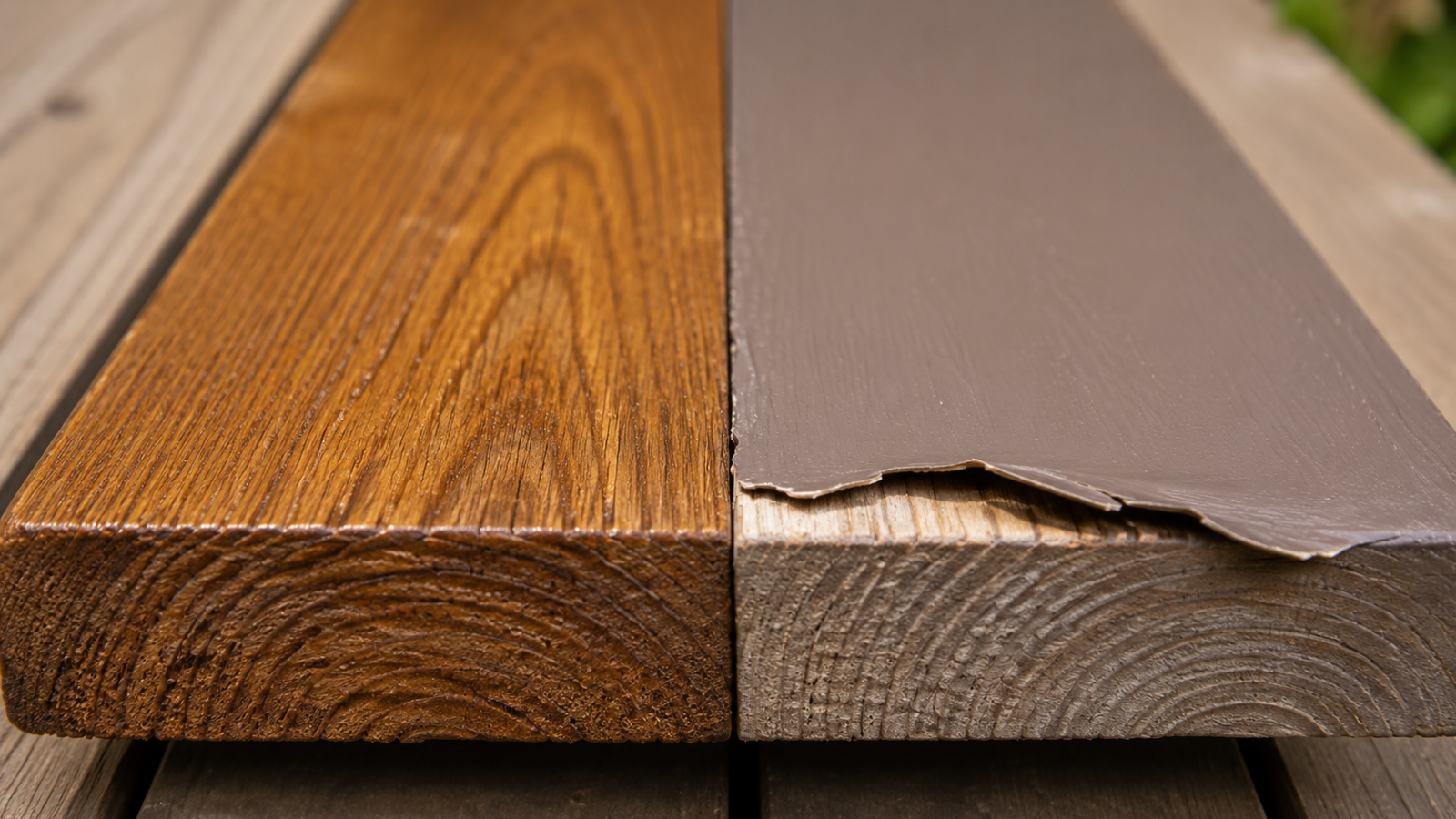
Whether a deck stain soaks into the wood or forms a film on top of it matters more than whether the can says oil or water. That one mechanical difference drives how the finish gives out, how long it holds, and how much work you’re signing up for the next time it wears down.
So this comparison is built on three things: where the product ends up, how it fails, and what the next refinish costs you in labor. We’re not ranking the two categories on a general better-or-worse scale. That question has no honest answer until you know what surface you’re staining and what you want the next refinish to look like.
At Woodrich Brand, every formula in our line was built in the 1990s for founder Russell Cissell’s own wood restoration crews around St. Louis. Russell has spent more than 30 years restoring decks, fences, and log homes, and he formulated or co-formulated everything we sell. Timber Oil Deep Penetrating Wood Stain, our flagship, is guaranteed not to crack or peel for a simple reason: there’s no surface film to crack. That same penetrate-or-film split is how the USDA Forest Products Laboratory sorts exterior wood finishes, and it’s the spine of everything below.
The Real Difference Between Oil-Based and Water-Based Deck Stain
The USDA Forest Products Laboratory divides exterior wood finishes into two groups: finishes that flow into the wood’s pores without leaving a continuous coating, and finishes that build a film across the surface. A true penetrating finish cannot crack or flake as a coating because there’s no continuous membrane to fracture. It loses pigment and water repellency gradually instead.
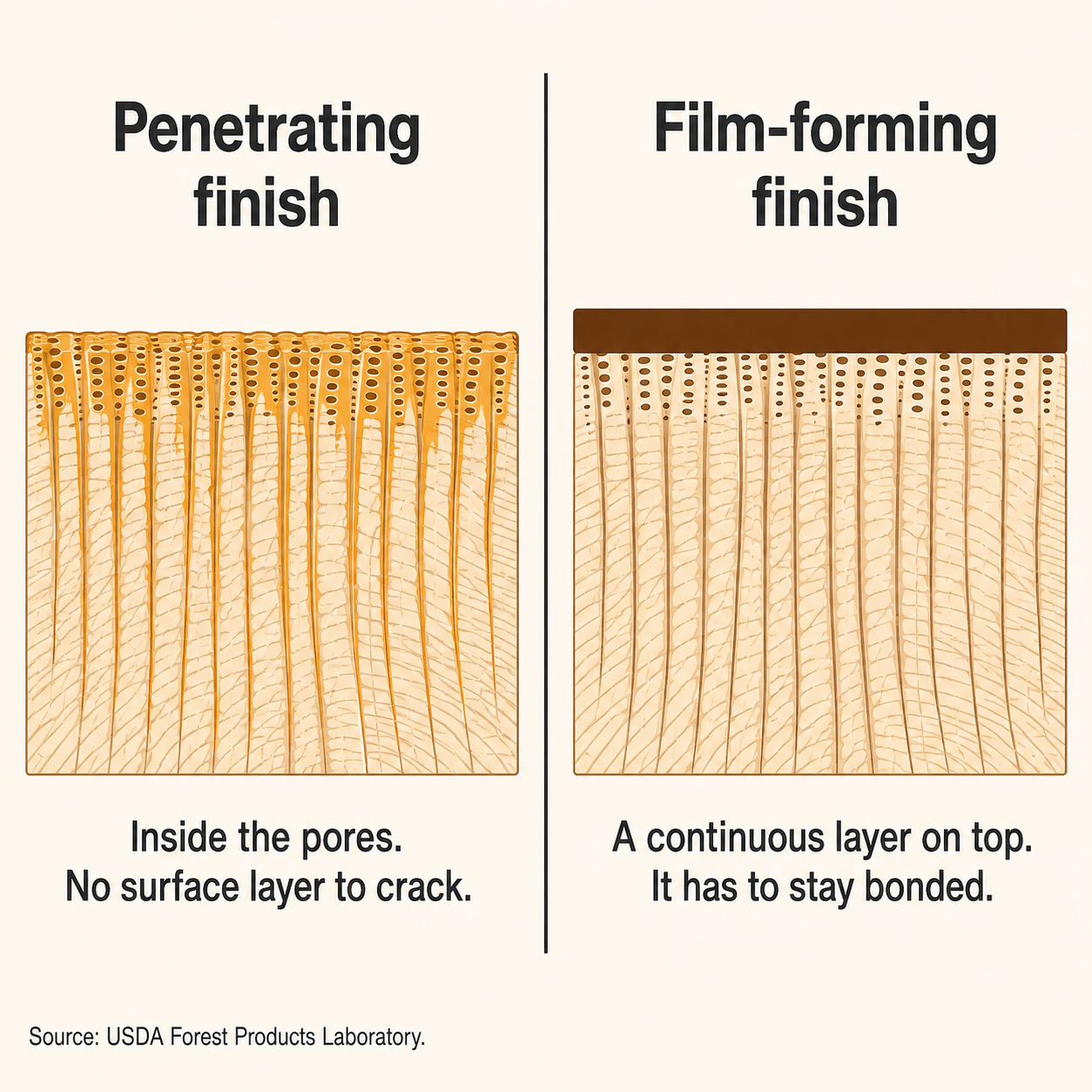
Oil and water are useful shorthand for that split. They aren’t the same thing as it.
- Oil-based solid-color stains form films. So does an oil-based semitransparent stain that’s over-applied, high in solids, or heavy on resin.
- Waterborne penetrating and semi-penetrating formulations exist. The Forest Products Laboratory notes that wood resists waterborne penetration, and that many of these products get their appearance from leaving a thin surface coating.
Treat the base as a screening clue rather than a verdict. The question you actually want answered on the shelf is whether the product ends up inside the wood or on top of it.
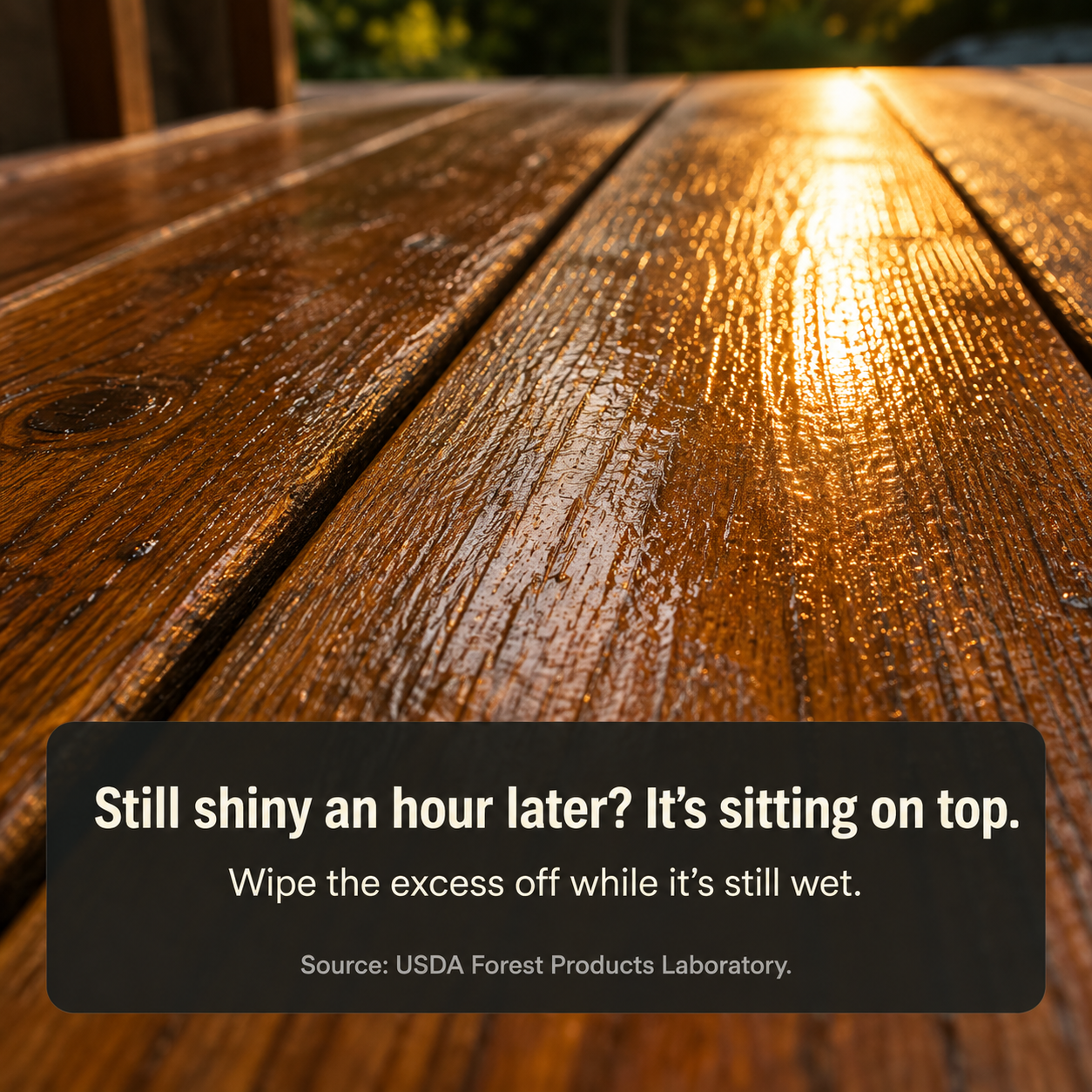
There’s a field test for this, and the timing matters. About an hour after application, look at the surface. If it’s shiny, the finish hasn’t penetrated and is sitting on top as a thin film. USDA notes that film can crack or peel within a year or two. Wipe the excess off while it’s still wet and you’ve solved it.
Oil-Based vs Water-Based Deck Stain: Side-by-Side Comparison
The comparison below assumes the common case: a penetrating oil-based semitransparent stain versus a film-forming water-based stain on horizontal deck boards.
| Variable | Penetrating oil-based stain | Film-forming water-based stain |
| Where it ends up | Inside the wood pores, no continuous surface layer | Bonded to the surface as a continuous film |
| How it fails | Gradual pigment loss and fading, roughly one pigment particle at a time | Cracks, flakes, and peels at edges and in patches |
| Dry time | Slower. Timber Oil is walkable in about 2 hours and dries in 2 to 3 days at 70°F or above | Faster. Latex systems are quick-drying, which shortens the rain window you need |
| Working time | Longer open time, easier to keep a wet edge | Shorter open time, which makes lap marks more likely |
| Cleanup | Mineral spirits | Water and detergent |
| Refinishing process | Clean the surface, verify it still absorbs, put down another application | Remove the failed film first, then clean, dry, and sand before anything new goes down |
| Touching up worn spots | Worn and protected areas can be evened out because there’s no peeling edge | Repairs leave a visible boundary where the old film stops |
| VOC compliance | Requires a genuinely low-VOC formulation in strict districts | Generally easier to formulate under very low limits |
| Appearance over time | Fades toward bare wood tone as pigment erodes | Holds opaque color well, particularly on vertical surfaces |
| Best fit | Horizontal decking, fences, siding, and log homes in softwood species | Vertical siding, skirting, railings, and anywhere an opaque paint-like color is the goal |
Why Film-Forming Deck Stains Crack and Peel
Most people land on this comparison because something peeled. Here’s the mechanism, which almost nobody explains on the shelf.
Wood is hygroscopic. It gains and loses moisture in response to the humidity and temperature around it, plus direct wetting from rain and dew. A coating can slow that exchange. Nothing stops it. And the moisture swings that matter are seasonal, not daily.
When wood takes on and gives up moisture, it changes dimension. Using USDA dimensional-change coefficients, a flat-sawn 5/4×6 deck board with an actual width of 5.5 inches, moving across the normal 6% to 14% moisture-content range, changes width by roughly:
- Western redcedar: 0.103 inches
- Loblolly pine: 0.114 inches
- Slash pine: 0.117 inches
- Second-growth redwood: 0.101 inches
That’s a tenth to nearly an eighth of an inch of movement per board. A continuous film has to span dozens of boards doing that, over and over, while staying bonded to surface fibers that sunlight is actively degrading. In USDA’s own weathering trials, one week of sun exposure before finishing measurably shortened paint life on low-density wood like cedar, while denser species showed little adhesion loss until three to four weeks. Once those surface fibers are degraded, film-forming coatings peel unless the surface gets sanded back to sound wood.
Thickness makes it worse. A brush-applied three-coat paint system runs about 4 to 5 mils thick. One or two coats of a low-solids solid-color stain may only reach 1 to 3 mils, which can be too thin to bridge raised grain and dimensional movement.
Then add the part specific to decks. Horizontal surfaces hold standing water, take foot traffic, and get direct overhead UV. Water that finds its way in through checks, fasteners, end grain, or a scratch raises moisture underneath the film and weakens adhesion from below. Water-based chemistry isn’t what dooms the film. The film-and-wood system fails because it can’t hold together through movement, moisture, UV damage, and wear all at once.
That’s why we built Timber Oil the way we did, and why we can promise a deck stain that won’t crack or peel. The guarantee doesn’t rest on adhesion. It rests on the absence of anything that needs to adhere.
How Penetrating Deck Stains Wear Out Instead
A penetrating finish doesn’t fail so much as deplete. USDA describes the process as losing protection roughly one pigment particle at a time. Pigment erodes, water repellency drops off, and the wood starts to look thirsty in the sunniest spots first.
What that buys you is a short maintenance list:
- Clean off dirt, dust, mildew, and loose weathered fibers.
- Confirm the wood still absorbs water rather than beading it.
- Let it dry.
- Put down another application without building up excess on the surface.
Worn and protected areas even out, because the old finish doesn’t leave a hard peeling edge for the new material to butt against.
The honest tradeoff is interval. A penetrating stain generally needs attention sooner than a properly built film system on a favorable vertical surface. You’re trading a longer interval for a much easier one.
One warning that applies to our own product as much as anyone’s: a stain labeled penetrating can still leave a film if you put down more than the wood can take. With Timber Oil the goal is saturation depth, not layer count. Apply heavily, let the wood drink, and when the surface stops absorbing and oil starts sitting on top, back-brush or wipe the excess off while it’s still wet. Tacky wood a day later means too much material stayed on the surface.
What Water-Based Deck Stains Do Well
We don’t sell a water-based product, so take this for what it’s worth: there are real reasons to buy one, and pretending otherwise would insult your intelligence.
They dry fast. Purdue Extension calls latex-based stains fast-drying, which matters when you have a narrow window between rain systems or need the deck back in service quickly. The tradeoff is shorter open time and a higher risk of lap marks.
Cleanup is water and detergent. No mineral spirits, no solvent disposal. Clemson Cooperative Extension does note that wash water shouldn’t go into a storm drain, waterway, or septic system, but it’s still an easier cleanup.
They hold opaque color well. For western redcedar and redwood siding, USDA reports that latex solid-color stains are more flexible than oil-based solid-color stains and resist UV, mildew, fading, flaking, and peeling better. High-quality acrylic latex house paint can outlast a good oil-based house paint for the same reason. Acrylic polymers stay flexible and resist sunlight better than aging oil binders.
They’re easy to formulate under very low VOC limits. In the strictest air districts, that’s a real advantage.
Notice where all of that lands. Fast return to service, easy cleanup, opaque color, vertical surfaces. That’s a coherent set of wins. If your project is siding, skirting, a fence you want painted rather than stained, or railings you want in a solid color, a good waterborne acrylic system is a defensible choice.
The problem is the horizontal deck floor. That’s the one surface where every weakness of a film gets tested at once, and it’s the surface most people are actually asking about.
How Long Each Type Lasts on a Deck
USDA’s service-life estimates are the best neutral numbers available. They’re averages for the contiguous United States, and they depend on climate and exposure.
| Deck surface | Tinted or deck finish | Semitransparent stain | Paint or solid-color stain |
| New, smooth-sawn decking | 1 to 2 years | 2 to 3 years | Rated low suitability, no expected life given |
| Weathered or saw-textured decking | 2 to 3 years | 3 to 6 years | Rated low suitability, no expected life given |
Note what’s missing from the right-hand column. USDA doesn’t publish an expected service life for paint or solid-color stain on decking, because it rates those systems as poorly suited to the application in the first place.
Vertical surfaces flip the picture. On smooth vertical-grain cedar or redwood siding, an ideal three-coat paint system is estimated at 10 to 15 years, and 15 to 20 years on saw-textured siding, while semitransparent stains run 2 to 4 years and 4 to 8 years respectively. Those paint numbers assume a full primer-plus-two-topcoat system. USDA says a two-coat system may deliver roughly half that.
On our own product, the reapplication interval tracks sun and orientation more than anything else:
- Horizontal decking in full sun: about 2 years between applications
- South-facing vertical walls and siding: 3 to 4 years
- Fences: 4 to 5 years
Treat sun, standing water, shade, and traffic as modifiers rather than fixed multipliers. USDA’s own table stops short of publishing a universal “full sun cuts life in half” rule, and peer-reviewed work on exterior coatings keeps finding that climate, species, pigment, prep, and orientation interact rather than stack neatly.
Can You Buy Oil-Based Deck Stain in California or the Northeast?
Yes. This is the assumption most articles get wrong, so it’s worth walking through.
VOC rules don’t ban oil chemistry. They set grams of VOC per liter by coating category, along with rules for labeling, testing, thinning, container sizes, and sell-through. A low-VOC oil stain can be perfectly legal in a restricted jurisdiction. What it can’t be is assumed, because the applicable limit depends on the district and on how the product is classified.
| Jurisdiction | Exterior stains | Wood coatings, including qualifying penetrating oils |
| Federal EPA baseline | 550 g/L (clear and semitransparent) | Not separately listed |
| OTC Phase II model rule | 250 g/L | 275 g/L |
| CARB Suggested Control Measure | 250 g/L | 275 g/L |
| South Coast AQMD Rule 1113 | 100 g/L | 275 g/L |
A few things fall out of that table worth saying plainly.
California isn’t one rule. Architectural coating limits in California are administered mostly by local air districts. CARB publishes a model measure that districts may adopt or modify, and areas without a local rule fall back to the federal one. “California bans oil-based stain” isn’t a statement about any actual regulation.
The Northeast isn’t automatically stricter than California. The OTC Phase II model permits 250 g/L for stains. South Coast AQMD permits 100 g/L. Six OTC members have adopted the Phase II provisions as of the commission’s April 2026 tracker: Connecticut, Delaware, Maryland, New Jersey, New York, and Rhode Island.
Penetrating oil is a named, regulated category. The OTC model rule’s wood-coatings definition specifically includes penetrating oils and clear stains, and sets them at 275 g/L. A regulator writing a limit for penetrating oils is not a regulator banning them.
Timber Oil is 100% oil-based with no water in the formula, and it’s low VOC and compliant in the Northeast Corridor, which enforces tighter limits than California’s statewide model. If you’re in a strict district, the practical move is to confirm the current limit for your specific air district and the product’s stated VOC before you order. We’re happy to check that with you on the Project Support Hotline.
What Refinishing Looks Like for Each Type
This is where the two paths genuinely diverge, and it’s the part of the decision most people underweight because it’s three years away.

USDA is unequivocal that paint or solid-color stain must be removed before a penetrating stain or water repellent can be applied. A penetrating product can’t penetrate through an intact film, and leaving patches of old film behind produces uneven absorption and blotchy results.
Every removal method comes with limitations:
- Power washing can lift loosely bonded coating, but pressure high enough to remove tightly adhered film will erode soft earlywood and gouge the surface.
- Dry sandblasting shouldn’t be used on wood you intend to refinish.
- Heat methods introduce fire hazards and are inappropriate for lead-containing paint.
- Chemical stripping means application, dwell time, scraping, possible neutralization, washing, drying, and sanding. Safer stripping products generally work slower, and some need several hours or an overnight dwell.
USDA describes exterior film removal as time-consuming, tedious, and unforgiving, and notes that the Forest Products Laboratory hasn’t established a best exterior stripping system. That’s a fair signal about the size of the job. If you’re already facing it, our guide to removing an existing stain or sealer walks through the process.
Here’s the compatibility question stated the way that actually helps:
| What’s on the wood now | What you want to apply | What has to happen first |
| Paint or solid-color film, failed or intact | Penetrating stain | Strip to bare, absorbent wood. Neutralize if a chemical stripping product was used, rinse, dry, sand raised or damaged fibers |
| Worn penetrating stain | Another compatible penetrating stain | Clean off dirt, loose fibers, and biological growth. Verify absorption, let the wood dry, reapply without surface buildup |
| Worn penetrating stain | Film-forming coating | Clean and dry, remove weathered fibers, sand as needed, use a complete primer and topcoat system |
| Sound film | Another film-forming coating | Clean, test adhesion, remove loose material, feather edges, dull or sand gloss, use the specified primer |
| Unknown store-brand finish | Anything | Test a small area. Does water bead or absorb? Does it peel in sheets or wear evenly? Answer that before you buy anything |
There’s no universal rule that oil can never go over water or the reverse. The real questions are whether a continuous film exists, whether it’s still bonded, and whether the wood underneath can absorb anything.
Which Deck Stain Should You Use?
Four variables settle it.
1. What the wood is and what condition it’s in. Species controls absorption. Cedar, pressure-treated pine, cypress, and redwood take a penetrating oil well. Dense tropical hardwoods like ipe, teak, mahogany, cambara, and garapa don’t, which is why they need a wiping system instead. If you’re unsure where your deck lands, our guide to choosing a stain for your wood type sorts it out, and new or pressure-treated lumber has its own moisture considerations before anything goes on. Weathered decks that have been cleaned and brightened generally absorb more and hold longer, which matches the USDA numbers above. Our process for restoring weathered wood covers that prep.
2. Your air district. Check the limit that applies where you live rather than assuming your state banned something.
3. What you want it to look like. If you want the grain visible and a natural wood tone, you want a semitransparent penetrating finish. For opaque, uniform, paint-like color, especially on vertical surfaces, a quality waterborne acrylic solid-color system is a legitimate answer and will hold that color longer than an oil solid-color stain will.
4. What you want maintenance to look like in three years. Weight this one heaviest. A penetrating finish means clean and reapply. A failed film means strip first, then everything else. Those aren’t comparable afternoons.
Common Questions About Oil and Water-Based Deck Stains
Can you put oil-based stain over water-based stain?
Only if the water-based product left no film, or the film has been completely removed. Oil can’t penetrate through an intact coating regardless of what that coating was made from. Wet a small test area: if water absorbs into the wood, you have absorbent wood. If it beads or sits, there’s still film in the way.
How much deck stain do you need?
Timber Oil covers 150 square feet per gallon, and that rate is the same across every size we sell. Measure length by width, multiply, divide by 150. A 12 by 20 foot deck is 240 square feet, or about 1.6 gallons. Rough, weathered, and porous wood absorbs more than new smooth boards, so build in room for a second application on an older deck.
Does oil-based deck stain turn orange over time?
No neutral deck-specific research establishes that modern oil stains universally shift orange. Drying oils can yellow through oxidative aging, and that chemistry is well documented in other contexts. On a deck, though, apparent darkening usually traces back to pigment selection, repeated over-application, surface film buildup, mildew, trapped dirt, or wood extractives.
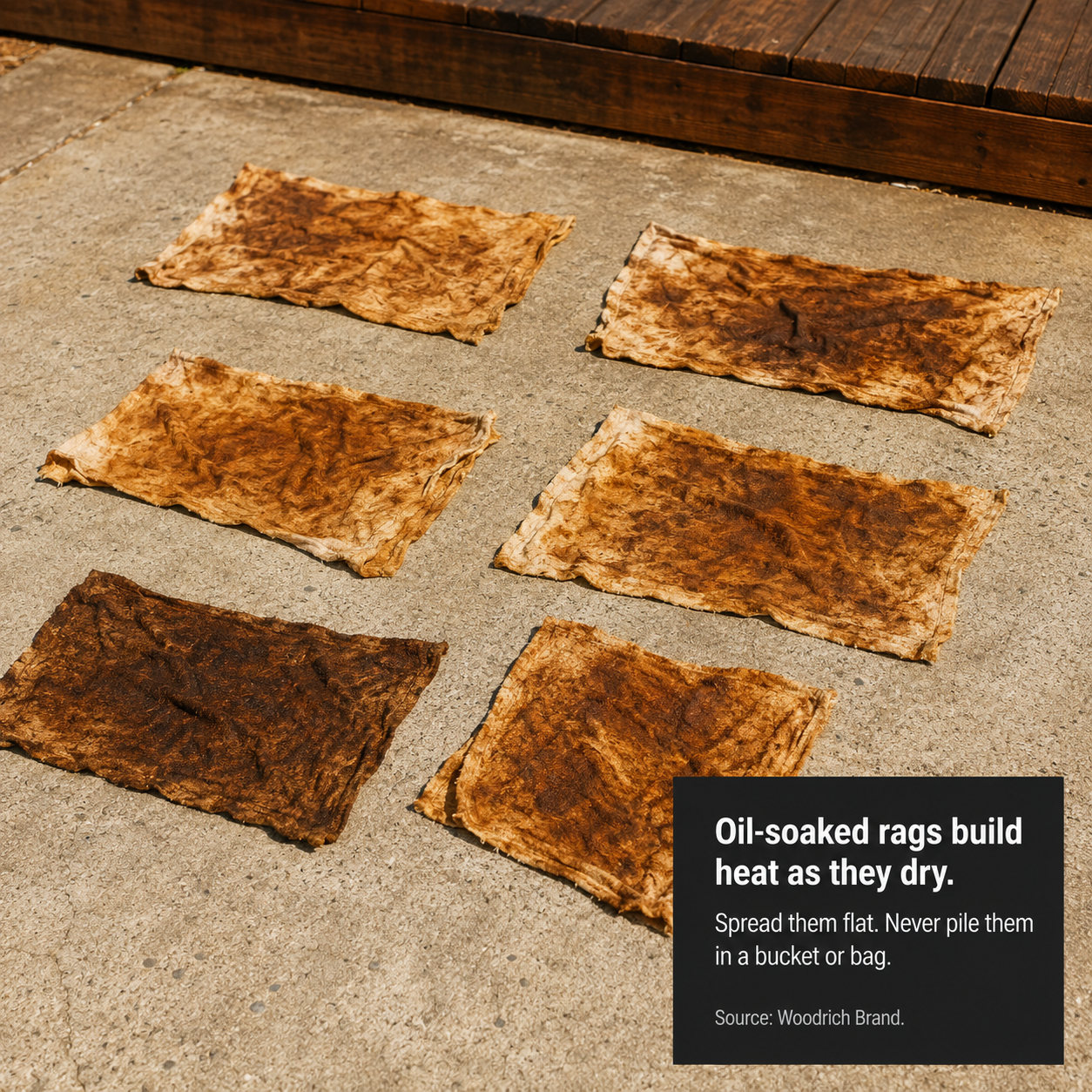
Are oily rags a fire hazard after staining?
Yes, and this applies to any oil-based finish. Oxidizing oil on rags and applicators generates heat and can self-ignite. Spread them flat to dry completely, or handle and dispose of them according to the product label and your local fire waste rules. Don’t pile them in a bucket or a trash bag.
Is water-based deck stain as durable as oil-based now?
Not as a category. Some waterborne formulations perform very well, and the chemistry has improved. But no strong neutral evidence shows that water-based semitransparent deck stains as a class now match penetrating oil stains on failure mode, maintenance burden, or horizontal-deck performance. Performance tracks resin chemistry, pigment, prep, species, and exposure more than it tracks the carrier.
Our Recommendation
For a horizontal softwood deck, we recommend a penetrating oil-based semitransparent stain, and the reason is the maintenance cycle rather than the first year of appearance. Cleaning and reapplying is a weekend. Stripping a failed film is a project.
That recommendation has a species limit worth stating clearly.
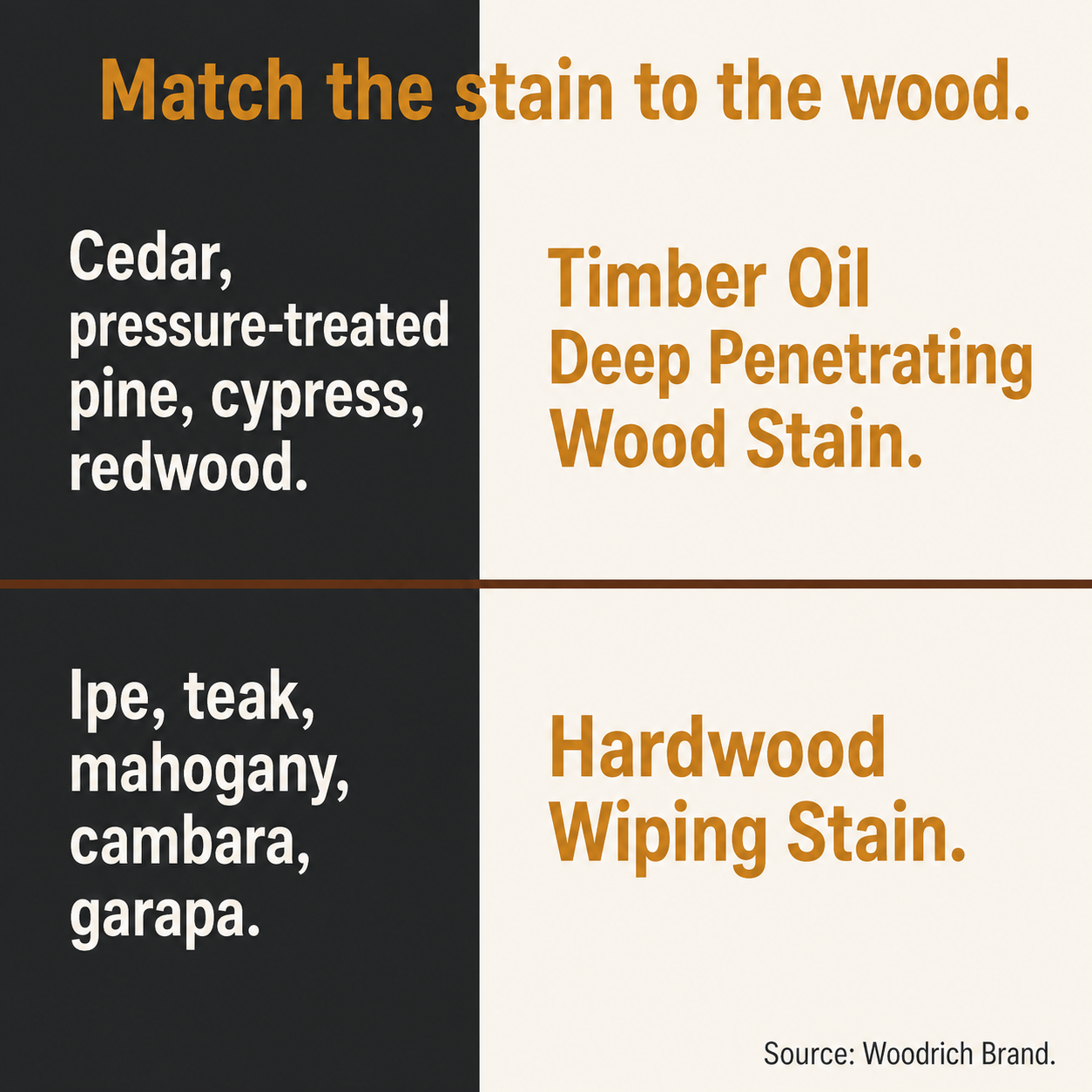
Timber Oil is formulated for cedar, pressure-treated pine, cypress, redwood, and similar softwoods. For ipe, teak, mahogany, cambara, or garapa, use our Hardwood Wiping Stain instead, which is built for species that resist absorption. If you’ve settled on oil but want to understand the sub-types before ordering, we break down the three types of oil-based exterior stains and sealers separately.
We’d rather you test that recommendation than take our word for it. The Timber Oil Sample Color Kit is $15 for five 2-ounce bottles, one of each pigmented color, and the $15 comes back to you as credit on your next order. Put them on your actual wood in your actual light before you commit to five gallons of anything.
And if you’re standing on a deck right now with no idea what’s already on it, text a photo to our Project Support Hotline at (636) 288-8512. Russell answers that line. He’s looked at a few thousand of these.