
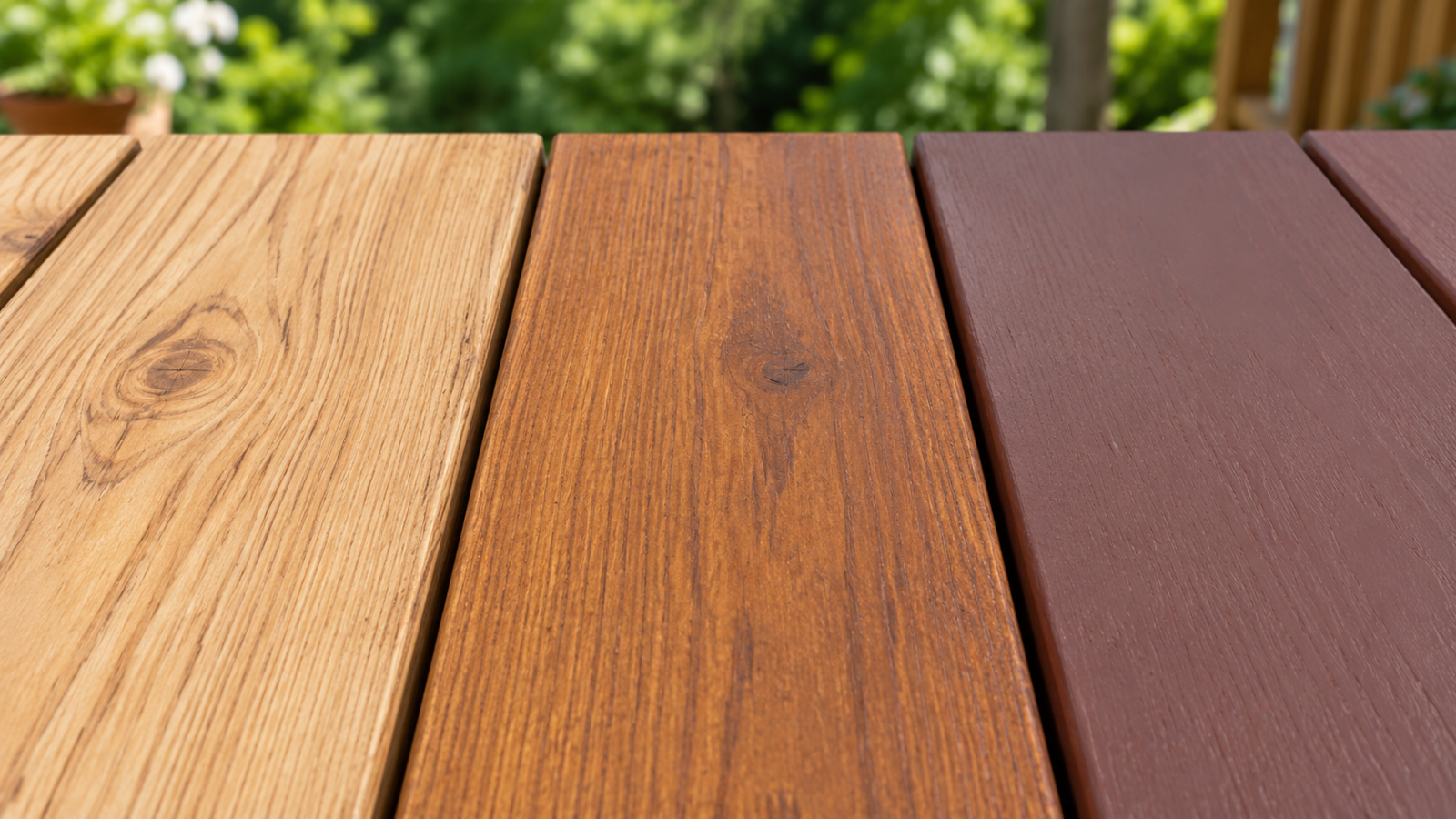
Opacity decides more than looks. The tier you pick controls how the finish wears out, how much work the next maintenance round takes, and whether you can change your mind in a few years without stripping the deck back to bare wood.
Opacity controls how much of the wood you still see. Pigment controls how much ultraviolet radiation reaches the wood underneath. Those are related, but they are not the same thing.
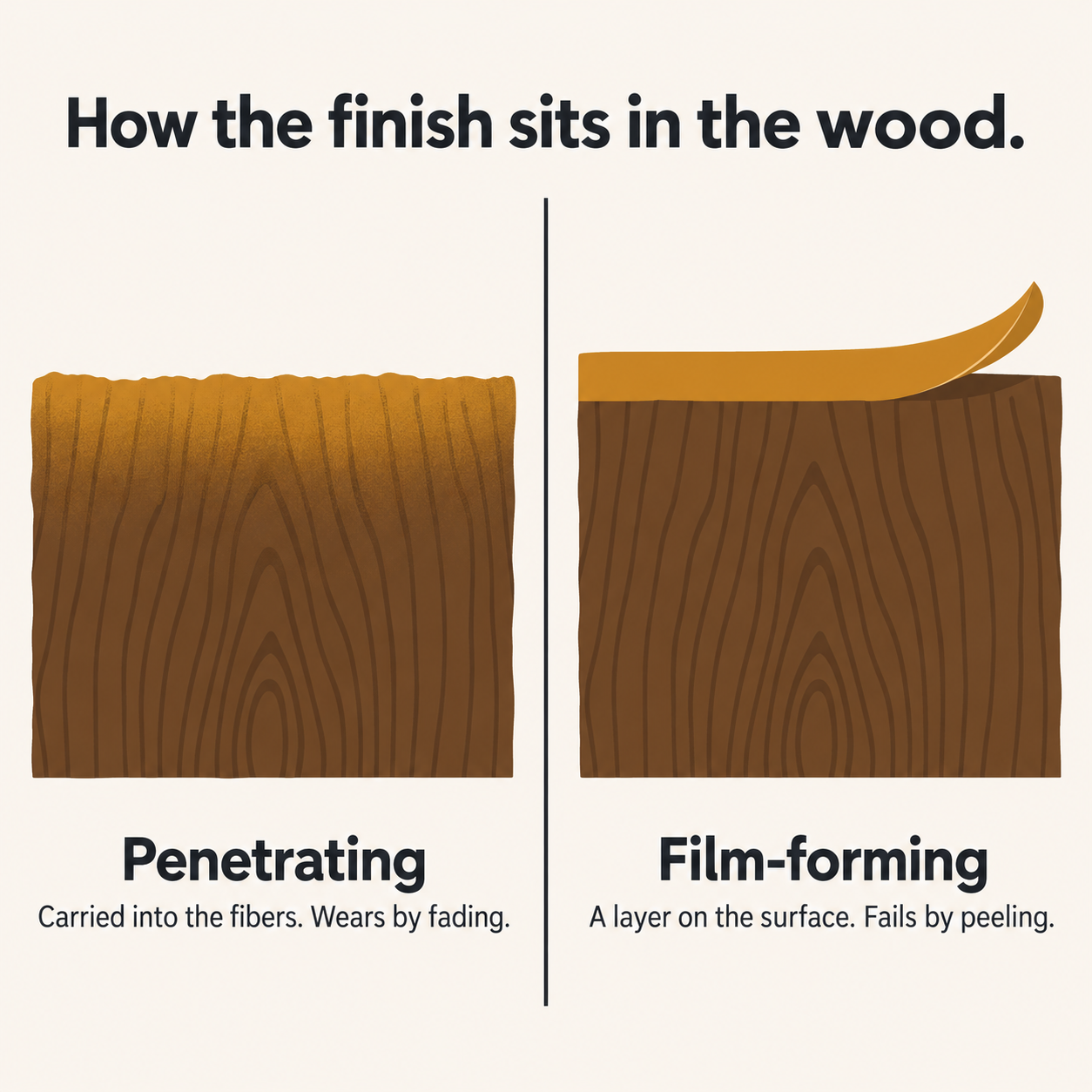
What the opacity label will not tell you is whether the finish soaks into the wood or dries as a film on top of it. That second question decides how the finish fails. A penetrating finish fades and thins out. A film finish loses adhesion and peels, and it has to come off before anything else goes down.
At Woodrich Brand, the most opaque finish we make is semi-transparent, and a good share of our phone calls come from people trying to undo a film finish. Russell Cissell formulated every product in the line and has been restoring decks, fences, siding, and log homes for more than 30 years. He still answers the Project Support Hotline himself. The two questions he fields most: what is on my deck right now, and how do I get it off.
Pigment type, not just pigment load
Not all pigment hides wood. Particle size and chemistry decide that.
Transparent iron oxides, usually called trans-oxides, are ground fine enough to absorb ultraviolet light while letting visible light through. USDA describes the same principle in finely pigmented finishes: the particles are sized close to the wavelength of UV radiation, so they block it while still appearing transparent. USDA’s deck bulletin makes the practical point directly, crediting finely ground trans-oxide pigment with raising service life from under a year to many years.
Clay and earth pigments work differently. They scatter visible light along with the UV. That is what makes a finish look muddy, and it is why the more of that pigment a can carries, the less wood you see.
So “heavily pigmented” tells you almost nothing on its own. Timber Oil is loaded with pigment and you still see the grain, because of what the pigment is rather than how much of it there is.
What the deck stain opacity levels mean
Exterior stains run along a spectrum from fully clear to fully opaque. The common labels, from least pigment to most:
- Clear or toner. Little to no pigment. The wood color shows through almost untouched. A toner carries a trace of pigment for a slight tint.
- Transparent. Light pigment load. Grain and color both stay clearly visible, with a hint of color added.
- Semi-transparent. Moderate pigment. Wood color shifts noticeably toward the stain color, and grain stays visible through it.
- Semi-solid. Heavy pigment. Grain pattern is faint. Most of what you see is stain color.
- Solid. Full hide. The wood’s color and grain pattern disappear. Surface texture usually still shows.
Those tiers are marketing descriptions, not a standardized scale. Federal architectural coating rules under 40 CFR 59.401 define “clear,” “semitransparent,” and “opaque” in plain optical terms, meaning whether the wood underneath can be seen distinctly, seen partially, or concealed. There is no pigment percentage or light transmission cutoff attached to any of them. Neither “toner” nor “semi-solid” appears as a federally defined tier at all.
ASTM’s guide for testing exterior wood stains and clear water repellents (D6763) does define an opaque stain: a pigmented composition that obscures the wood’s grain and color while leaving surface texture perceptible, with “solid color” and “solid hide” treated as the same thing. Solid stain hides the grain pattern without making the boards look flat.
Practically, two products both labeled semi-transparent can look different on the same board, and can behave differently after two summers. The label tells you roughly what to expect visually. It tells you nothing about the formula.
Penetrating vs film-forming deck stain
A penetrating finish carries pigment and oil down into the wood fibers instead of building a layer on the surface. There is no continuous film, so there is nothing to lose adhesion. It wears by fading, graying, eroding, and losing water repellency. That is also why it goes on in applications rather than coats. You are saturating wood, not stacking layers on it.
A film-forming finish dries as a continuous layer bonded to the surface. While that bond holds, the film does real work. It shields the wood completely and can last a long time on the right surface. When the bond gives up, it gives up where you can see it: cracking, flaking, peeling at board edges, moisture trapped underneath.
Coverage rate tells you something the label will not. A finish that spreads 400 or 500 square feet to the gallon is not going into the wood. It is sitting on it. Penetrating finishes get consumed by the wood, so the thirstier the boards, the less ground a gallon covers.
We rate Timber Oil at 150 square feet per gallon. That is a worst case, based on aged rough-cut cedar that drinks everything you give it. Smooth new boards will take less. But the number runs low for the same reason the finish works.
The USDA Forest Products Laboratory has been explicit about this on decks specifically. Its bulletin Finishes for Wood Decks points to two stresses that make horizontal boards hard on film finishes: constant shrink and swell as moisture content changes, and mechanical wear from foot traffic. Its conclusion is that penetrating finishes give better overall deck performance and are easier to reapply than paints and solid-color stains.
Semi-transparent does not mean penetrating.
USDA’s 1999 report Selection and Application of Exterior Stains for Wood traces how the word “stain” drifted away from chemistry. It originally meant a penetrating finish. Then non-penetrating products started getting marketed as stains too. The report calls out latex semi-transparent stains by name: their see-through appearance can come from a thin polymer film rather than from pigment carried into the wood, and that film can eventually flake.
Waterborne products are more likely to form a film, because wood resists water penetration. Treat that as a clue rather than a test. Waterborne penetrating systems exist, and an oil finish applied too heavily can leave material sitting on the surface instead of in the wood. Read the formulation, then watch how the finish behaves once it cures.
Solid stain is the one place where the two axes converge. In conventional exterior wood finishing systems, solid-color stains are film-forming coatings, applied and maintained much like paint.
Deck stain opacity comparison
| Opacity level | Grain visibility | Typical UV protection | Typical chemistry | How it fails | Getting back to bare wood |
|---|---|---|---|---|---|
| Clear / toner | Full grain and natural color | Minimal from pigment | Usually penetrating | Fades fast, wood grays underneath | Easy. Clean and reapply |
| Transparent | Grain fully visible, slight color shift | Low | Usually penetrating | Gradual fading and erosion | Easy. Clean and reapply |
| Semi-transparent | Grain visible through added color | Moderate to good | Penetrating or film-forming depending on formula | Fades if penetrating, can peel if it films | Easy if penetrating. Needs a stripping product if it formed a film |
| Semi-solid | Faint grain, mostly stain color | High | Commonly film-forming | Wear-through in traffic areas, edge peeling | Needs a stripping product |
| Solid | Color and grain hidden, texture remains | Highest | Film-forming | Cracking, flaking, peeling, moisture trapped underneath | Needs a stripping product, sometimes sanding after |
Those UV ratings assume conventional pigment. A finish built on transparent oxides can sit in the semi-transparent row and still deliver UV protection well above what that row suggests.
How pigment controls UV protection
The instinct that darker lasts longer is close, but it names the wrong variable. Darker is not what protects the wood. Pigment is, and the type of pigment more than the amount of it.
A semi-transparent finish lets some light through by definition. Ultraviolet radiation reaches the wood surface, photo-oxidizes the fibers, and degrades them. Pigment particles block that radiation before it lands. More UV-blocking pigment, more protection for the wood underneath.
Ultraviolet light does not penetrate wood deeply. Research at the Forest Products Laboratory put the limit at roughly 75 micrometers. That is why this is a surface problem, and why something sitting in that top layer blocking UV changes the outcome so much.
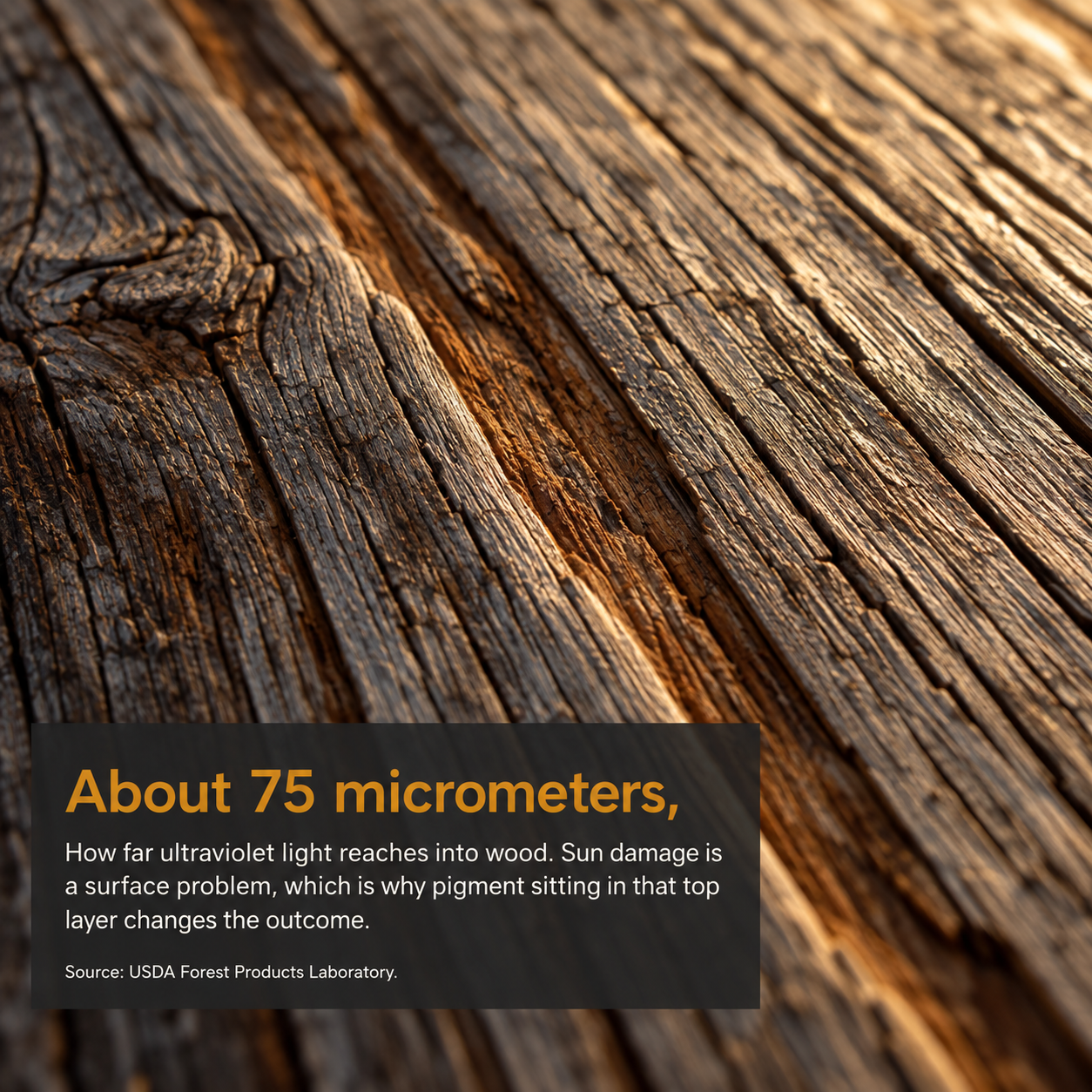
A genuinely unpigmented penetrating clear gives the wood very little UV shielding. USDA’s deck bulletin puts an unpigmented water-repellent finish at about one year on exposed decking. Pigment is what extends that.
This is why Timber Oil uses trans-oxide pigments. It carries a heavy pigment load and still shows grain, because trans-oxides are opaque to ultraviolet and transparent to visible light. Clear Advantage is the clear version of Timber Oil, meant for minimal color change and for mixing custom tones.
How often you will be reapplying, by surface
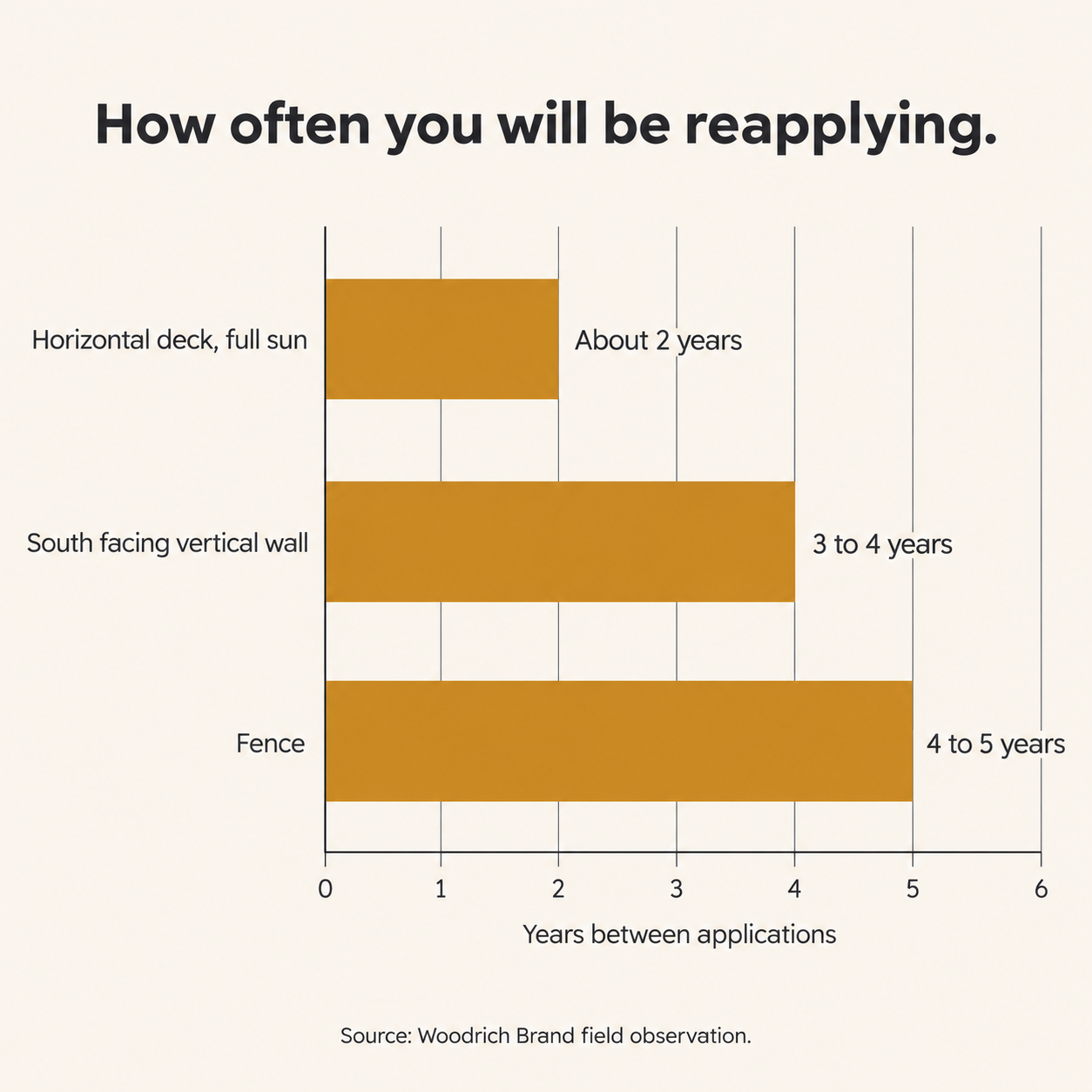
Across three decades of restoration work and customer projects, the intervals we give people are roughly 2 years for a horizontal deck in full sun, 3 to 4 years for a south-facing vertical wall, and 4 to 5 years for a fence. Those are Woodrich numbers based on what we see, not published industry standards. A north-facing or shaded surface generally goes longer.
The USDA service-life figures back these up. The best published reference is Table 16-4 in the 2010 Wood Handbook, Chapter 16 (FPL-GTR-190). USDA treats these as general expected service life rather than guarantees, since climate, exposure, prep, formulation, species, texture, and how much finish went on all move the number.
| Surface | Lightly pigmented or tinted | Semi-transparent | Solid color |
|---|---|---|---|
| New, smooth deck boards | 1 to 2 years | 2 to 3 years | Rated low suitability, no interval assigned |
| Weathered or saw-textured deck boards | 2 to 3 years | 3 to 6 years | Rated low suitability, no interval assigned |
| Cedar or redwood siding, smooth | 1 to 2 years | 2 to 4 years | 8 to 12 years |
| Cedar or redwood siding, saw-textured | 2 to 3 years | 4 to 8 years | 10 to 15 years |
| Pine, fir, or spruce siding, smooth | 1 to 2 years | 2 to 3 years | 6 to 8 years |
| Pine, fir, or spruce siding, saw-textured | 2 to 3 years | 4 to 7 years | 8 to 10 years |
Solid color on vertical siding can run 6 to 15 years, far longer than a penetrating semi-transparent, but solid color on deck boards gets no service life at all: USDA rates it low suitability for that surface.
One counterintuitive detail from USDA’s 1999 report: weathered or rough-sawn wood often holds more penetrating stain than freshly planed wood. That is why a second application on an older deck sometimes outlasts the first one on new boards, and why over-applying to tight new wood leaves a shiny residue instead of protection.
Deck boards, rails, and fences behave differently
The right opacity call can be different for the floor and the rails of the same deck.
Horizontal walking surfaces get the worst of it. Standing water, direct sun, foot traffic grinding grit into the boards, and constant moisture-driven movement. This is where USDA steers toward penetrating finishes and away from film systems.
USDA notes that paints and solid-color stains can perform quite well on railings, where the film is not being walked on and the construction can be detailed to avoid trapping moisture. A painted rail over a natural deck floor works fine. The floor is below the rails, so stripping it later will not run product down your posts. The one thing to watch is overspray. If you are spraying HD-80 on the floor, mask the painted components first. EFC-38 does not carry the same concern.
Fences sit between the two. Both faces are vertical and nobody walks on them, but sun exposure is often brutal and unshaded, and the south or west face will always come due before the other side. USDA does not treat solid finishes as a safe default here either: its 1999 report says opaque stains should not be used on structures such as decks and fences.
Can you change your mind later?
Going from a penetrating finish to a solid one is not our lane. We do not make solid stains and we do not recommend them, so the honest answer is that most manufacturers of solid finishes are going to tell you to strip the wood first. Ask them, not us.
Coming the other direction is where our phone rings.
USDA states it plainly: a penetrating semi-transparent stain cannot be applied over a film-forming finish unless the film is completely removed. Once solid pigment has bonded to the surface, a lighter finish applied over it has nowhere to go. It sits on top, dries blotchy, and fails early.
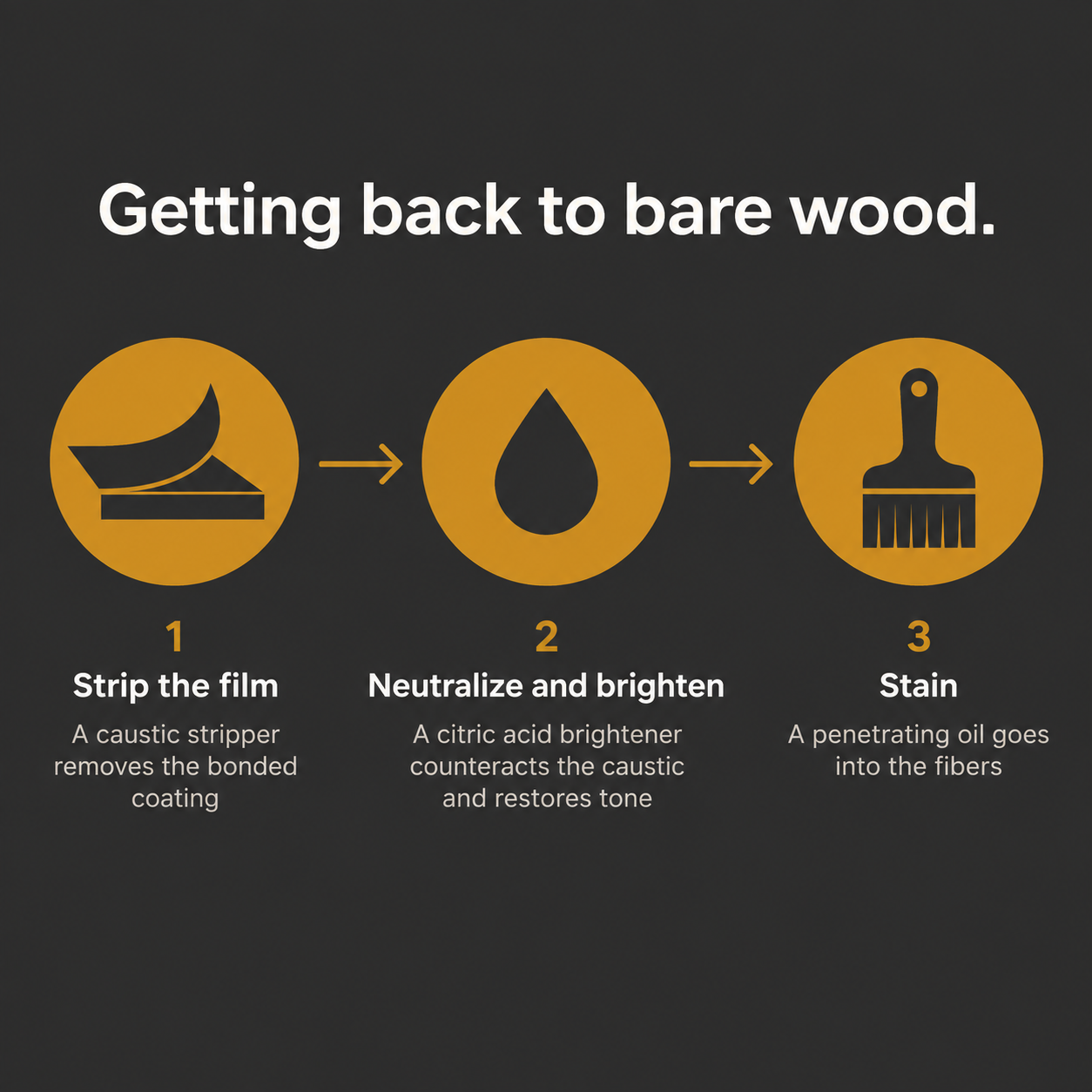
The sequence is a caustic stripping product to remove the film, then a citric acid brightener to counteract the caustic and restore the wood’s tone, then stain. Our Heavy Duty Stripping Kit pairs HD-80 with Citralic for that reason.
One exception worth naming. HD-80 is not a recommended solution for thick deck-restore coatings, the kind sold as a way to resurface a failing deck. Those are a different removal problem. If that is what is on your boards, send us a photo before you buy anything.
When solid stain is the right call
We do not make a solid stain or a semi-solid stain. That is a real limit on what we can tell you about them, so what follows is where they make sense, not how to use them.
Solid color earns its place when uniform appearance matters more than seeing the wood:
- Patched or repaired decks. Replacement boards rarely match the originals in color or weathering. Solid stain erases the difference. A translucent finish puts it on display.
- Mismatched lumber. Mixed species, mixed ages, or salvaged material that will never look like one deck under a translucent finish.
- Wood that already has solid stain or paint on it. If the existing film is sound and well bonded, recoating with another solid stain is far less work than getting back to bare wood.
- Vertical components where you want a specific color. Rails, posts, pergolas, and siding, where the film is not being walked on and the service life numbers actually favor it.
It is a trade. You get longer intervals between coats on vertical surfaces and complete color control. You accept a harder remediation job whenever the film eventually gives up, and you accept that going back to visible grain means taking the film off first.
If the wood is sound, the boards match, and you like how the grain looks, a penetrating semi-transparent finish keeps every option open.
How wood species affects the choice
Species affects how much finish the wood absorbs and how much stress a film has to survive, though it does not hand you an opacity answer on its own.
Southern yellow pine and Douglas fir are harder on film finishes because dense latewood bands sit next to lower-density earlywood, and the two zones move differently as moisture changes. That puts stress right at the coating interface. On pressure-treated pine deck boards, that is one more argument for a finish that penetrates instead of bridging the surface.
Western redcedar and redwood are lower density with less severe latewood banding, and they historically hold paint well. Their natural extractives can migrate and discolor light-colored opaque coatings if moisture carries them to the surface. Cypress carries significant extractives and aromatic oils that can interfere with some film finishes.
Timber Oil is formulated for softwoods: cedar, pressure-treated pine, cypress, redwood, and similar species. Our softwood stains and sealers are all built around penetration for exactly the reasons above.
Dense tropical hardwoods are a separate category. Ipe, teak, mahogany, cambara, and garapa have grain tight enough that standard stains cannot penetrate properly and will fail early. Those species need the Hardwood Wiping Stain, which is applied wet, then wiped back so only what the wood can take stays in it. If you are still working out what your wood needs, our guide to choosing deck stain for your wood type goes species by species.
Test the color on your own wood first
Opacity and color both read differently on your boards than on a website swatch or a printed chip. Species, age, prep, and how much the surface absorbs all shift the result.
Timber Oil is semi-transparent and 100% oil-based, with no water at all. It penetrates rather than films, which is why we guarantee it will not crack or peel.
Before anyone commits to a full order, we point them to the Timber Oil Sample Color Kit. It is $15 for five 2-ounce bottles, one of each pigmented color, and that $15 comes off your full order afterward. You can also mix samples to build a custom color before buying gallons of anything. Guessing at color on a 500 square foot deck is an expensive way to find out you guessed wrong.
Common questions about deck stain opacity
Can you put semi-transparent stain over solid stain?
No. Once solid pigment has bonded to the wood, a penetrating finish applied over it has nowhere to go. It sits on the surface, dries blotchy, and fails early. USDA guidance says a penetrating stain cannot be applied over a film-forming finish unless the film has been completely removed, and the Wood Handbook puts it flatly: do not apply oil-based semitransparent stains over solid-color stain or paint. The solid stain has to come off with a caustic stripping product first, followed by a citric acid brightener to counteract it.
Is semi-transparent stain always penetrating?
No. Semi-transparent describes how much wood shows through, not how the finish sits on the wood. USDA has documented latex semi-transparent stains that get their appearance from a thin surface film rather than pigment carried into the fibers, and that film can flake later. Waterborne products are more likely to form a film, but formulation and application both matter. Watch how the product behaves once cured rather than trusting the opacity label.
Does clear deck stain protect against UV?
A genuinely unpigmented penetrating clear provides very little UV shielding for the wood. USDA puts unpigmented water-repellent finishes at roughly one year on exposed decking. Pigment is what blocks ultraviolet light before it reaches the wood surface, so adding even a light tint extends service life measurably. Clear finishes get chosen for appearance and water repellency, not sun protection.
How long does solid stain last on a deck?
USDA’s current service life table does not assign an interval to solid-color stain on deck boards, rating it low suitability for that surface because of foot traffic and moisture-driven board movement. On vertical siding it performs very differently, with estimates running 8 to 12 years on smooth cedar or redwood and 10 to 15 years on saw-textured surfaces.
Which stain opacity is best for pressure-treated pine?
Semi-transparent penetrating finishes generally suit pressure-treated pine decking best. Southern yellow pine has dense latewood bands next to softer earlywood, and those zones move differently with moisture changes, which puts stress on any surface film. A finish that penetrates moves with the wood instead of bridging it. Solid stain still makes sense on pine if boards have been replaced and you want uniform color.
Not sure what you have on your deck right now?
The fastest way to sort this out is to show us. Text a photo of your deck to our Project Support Hotline at (636) 288-8512, or send it through our contact form, and we will tell you what finish is on there, whether it needs cleaning or stripping, and what product and quantity your project calls for.
We have been selling this online since 1998, and Woodrich is family owned and operated, a husband-and-wife team. We would rather spend ten minutes getting you to the right answer than sell you the wrong product twice.