
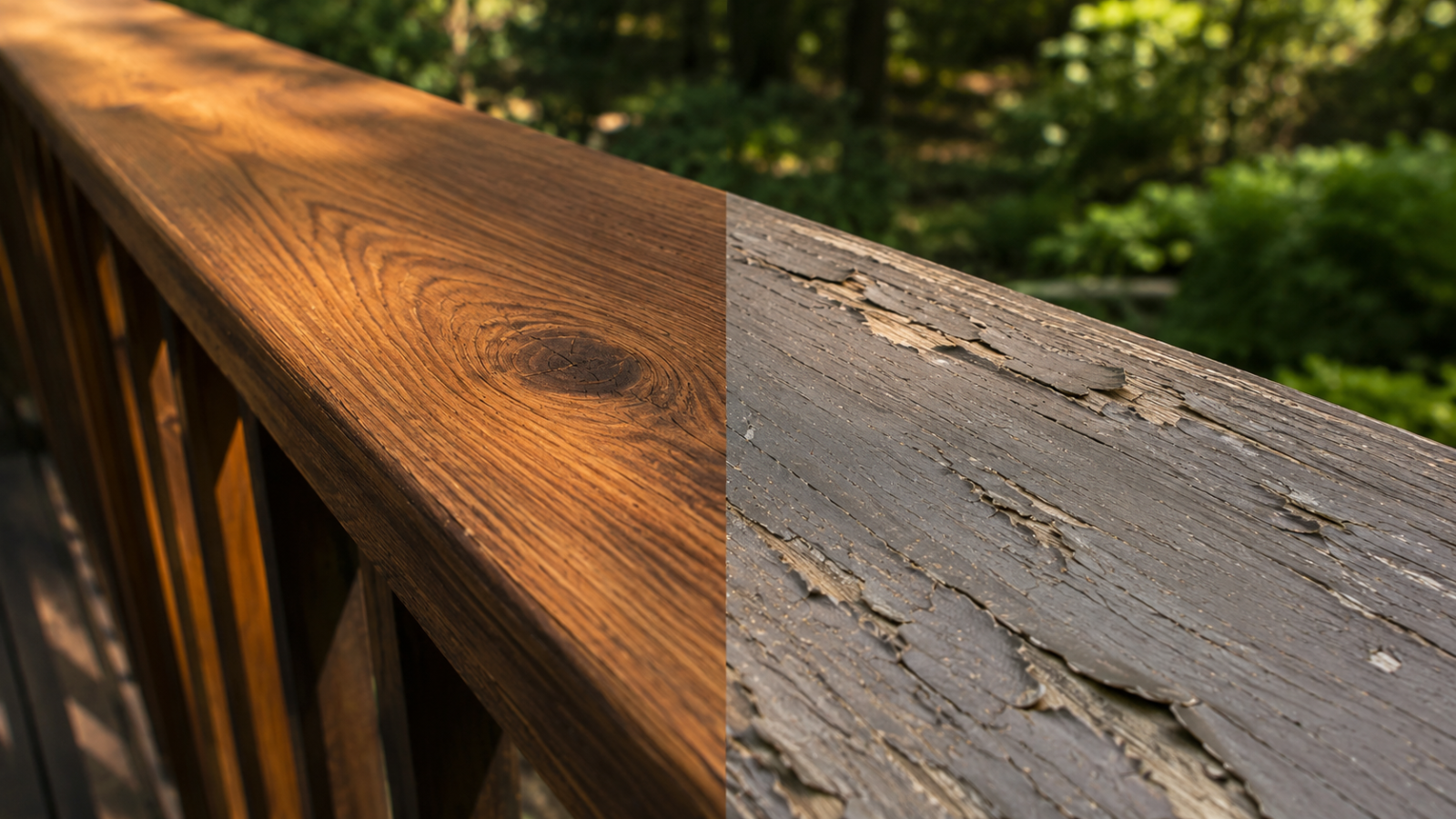
Every exterior stain gets sorted into one of two buckets, oil-based or water-based, and that is the wrong place to start the comparison. Those labels describe the carrier liquid, meaning what the pigment and resin are suspended in until the product dries. They say nothing about how the finish behaves once that liquid evaporates, and the behavior is what decides how long your finish lasts, how it eventually fails, and how much work the next refinish takes. The variable that actually drives performance is whether the product soaks into the wood or forms a film on the surface.
Most oil-based exterior stains penetrate. Most water-based exterior stains form a film. The correlation is close enough that the two ideas get treated as the same thing, and that is exactly why published comparisons contradict each other. One manufacturer page tells you oil lasts longer. The next tells you water-based does. Both present it as settled fact, and neither says what it is actually measuring. Confusing the label on the can with the mechanism underneath it is how people end up with a finish that cracks two years in.
At Woodrich Brand, our founder Russell Cissell has spent 30+ years restoring decks, fences, siding, and log homes. Every product in our line was formulated for our own restoration crews before we ever sold a can of it. We also sell HD-80, the heavy-duty stripping product used to remove failed film-forming finishes, so we see the aftermath of peeling stains as a routine part of the business. That gives us a perspective most stain manufacturers don’t have: we spend as much time removing finishes that failed as we do applying ones that work.
How Oil-Based and Water-Based Stains Work Differently
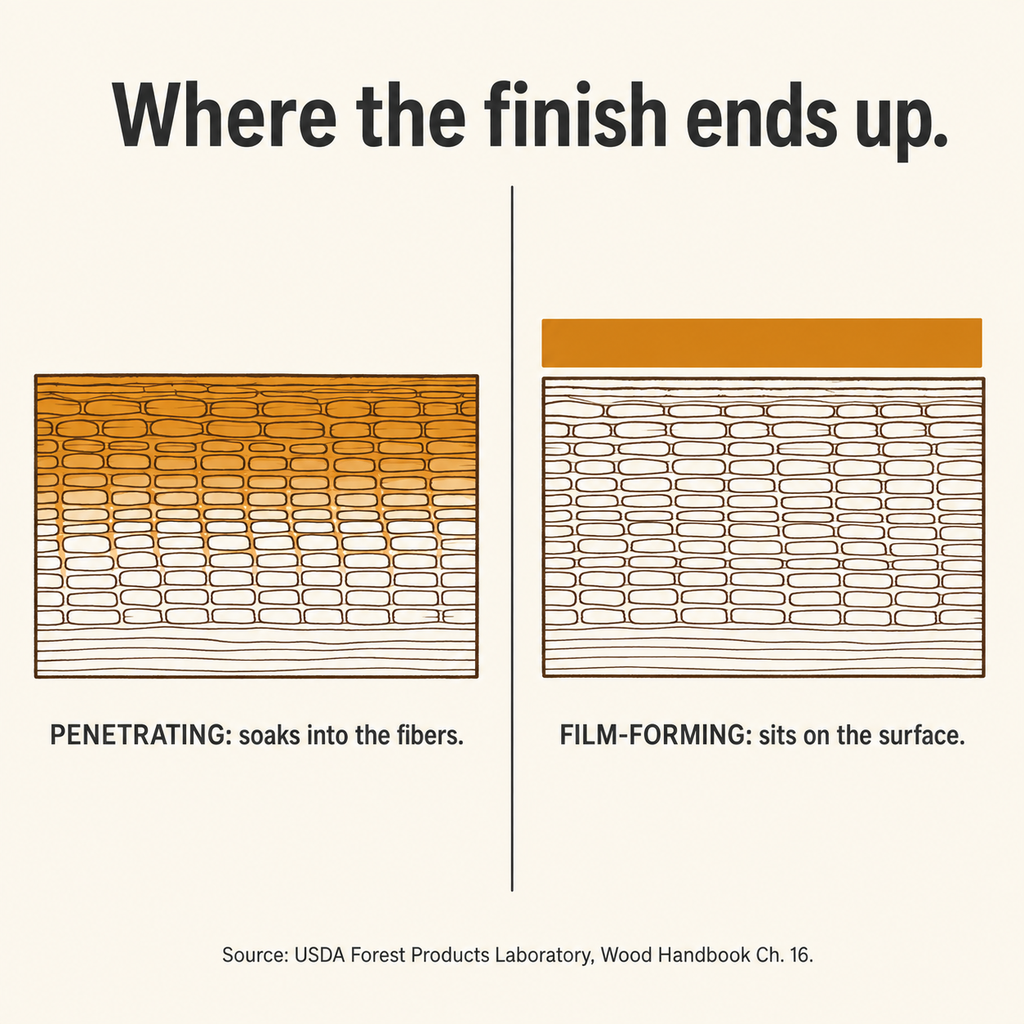
The USDA Forest Products Laboratory (FPL) splits exterior finishes into two categories: penetrating finishes and film-forming finishes. That distinction, not the oil-vs.-water label, is what determines performance.
Penetrating finishes soak into the wood fibers and occupy the space within the cell structure. They don’t form a continuous layer on the surface. Oil-based semitransparent stains are the most common example. The oil carries the pigments and resins into the wood, and as the carrier evaporates, those solids stay embedded. No surface film means nothing to crack or peel.
Film-forming finishes create a layer on top of the wood surface. Paint is the most obvious example, but most water-based (latex) semitransparent stains also fall into this category. According to FPL, latex semitransparent stains form a thin film on the surface rather than penetrating the wood. The synthetic polymers seal the surface and provide water repellency, but they sit on top of the wood rather than inside it.
Here is where the confusion starts. Oil-based almost always means penetrating, and water-based almost always means film-forming, so the two labels get used interchangeably. But the two pairs describe different things:
- Oil-based and water-based tell you what carries the product into the wood (the solvent system).
- Penetrating and film-forming tell you what the product does once the carrier leaves (the finish mechanism).
Waterborne penetrating stains do exist. FPL documents their arrival around 1980, and small-particle acrylic emulsions engineered for wood penetration are available. Film-forming oil finishes also exist: old oil-alkyd paints are film-formers by definition. So the labels and the behavior are correlated, not identical. When you’re comparing stain products, what matters is whether the finish goes into the wood or sits on the wood.
For more on how oil-based stains break down into subtypes and how the penetration mechanism works at a chemical level, see our explanation of the science behind oil-based sealers.
Oil-Based vs. Water-Based Stain: Side-by-Side Comparison
The table below compares oil-based penetrating stain against water-based film-forming stain, which is how these products most commonly behave. Keep in mind that exceptions exist in both directions (see the section on hybrid and mislabeled formulas below).
| Feature | Oil-Based (typically penetrating) | Water-Based (typically film-forming) |
| How it works | Soaks into wood fibers; no surface film | Forms a thin film on the wood surface |
| Failure mode | Fades and erodes gradually | Cracks, peels, and lifts at board edges |
| Refinish process | Clean the surface and reapply | Strip or sand the failed film, then recoat |
| Dry time (touch) | Approximately 4 hours | As fast as 30 minutes |
| Recoat window | Typically 24 to 48 hours between applications | Often 2 to 4 hours |
| Cleanup | Mineral spirits or paint thinner | Soap and water |
| Odor | Noticeable solvent smell during application | Low odor |
| VOC range | Varies by formulation; low-VOC options available | Generally lower |
| Mildew resistance | Oil and alkyd resins can feed mildew; mildewcide package is the deciding factor | Acrylic binders are more mildew-resistant than oil; still requires mildewcide |
| Best exterior use | Decks, fences, siding, pergolas, log homes | Solid-color applications; projects requiring fast turnaround |
| Repeat refinishing | Clean and apply; no scraping needed | Must strip if film fails before recoating |
How Oil-Based and Water-Based Stains Fail Differently
This is where the comparison matters most, because the failure mode determines what your next refinish looks like.
Penetrating oil-based stain: fading and erosion
A penetrating finish wears by slowly losing pigment from UV exposure and foot traffic. FPL describes this as gradual erosion: the color fades, the surface looks chalky or dull, and the wood grain starts showing through. It looks tired, but the wood itself is not damaged.
The important part is what it does not do. Because a penetrating stain has no continuous surface film, it cannot blister, crack, or peel, even if moisture enters the wood from below. The stain moves with the wood as it swells and contracts through seasonal humidity changes. On species with abrupt density transitions between earlywood and latewood (southern yellow pine, Douglas-fir), that flexibility matters, because those boards put the most stress on any surface coating.
When the finish has faded enough that it is no longer protecting the wood, you clean the surface and apply a fresh application. No stripping, no sanding, no chemical removal. FPL confirms that penetrating stains do not require scraping before refinishing: a stiff brush to remove loose material, then reapply. The second application often gets longer service life because it penetrates the surface checks that open as wood weathers.
Film-forming water-based stain: cracking and peeling
A film-forming finish fails by cracking and lifting. As wood cycles through moisture content (outdoor wood typically moves between roughly 9% and 14% equilibrium moisture content across most of the US), it expands and shrinks. The film on the surface cannot flex enough to keep up, and it breaks.
Once the film breaks, moisture gets underneath and accelerates the failure. The finish starts peeling in sheets, lifting at board edges, and exposing bare wood in patches while other areas still have an intact film. You cannot simply apply a new coat over this. The old film has to come off first, either by chemical stripping, power sanding, or both.
This is the part most comparison articles skip. Year one with a film-forming stain can look great: consistent sheen, clean appearance, fast application. The problem shows up in year two or three, and the cost is not just another can of stain. It is the labor and materials to remove what failed before you can start over.

If your deck is currently cracking or peeling, that failed film has to come off before you recoat. We walk through the clean, strip, and brighten process in our guide to wood restoration kits for your deck, fence, or siding.
Why Published Longevity Numbers Are Misleading
If you read five stain reviews, you’ll get five different longevity claims, and at least two of them will directly contradict each other. There is a reason for that.
FPL’s own data makes service life contingent on at least four variables that most comparison articles ignore:
- Pigment concentration. FPL states directly that the higher the pigment concentration, the longer the service life. Two stains in the same category with different pigment loads will last different amounts of time, and the pigment load is rarely disclosed.
- Surface orientation. A horizontal deck surface in full sun takes the most UV and water abuse. A vertical fence panel gets far less. Quoting one number for both is meaningless.
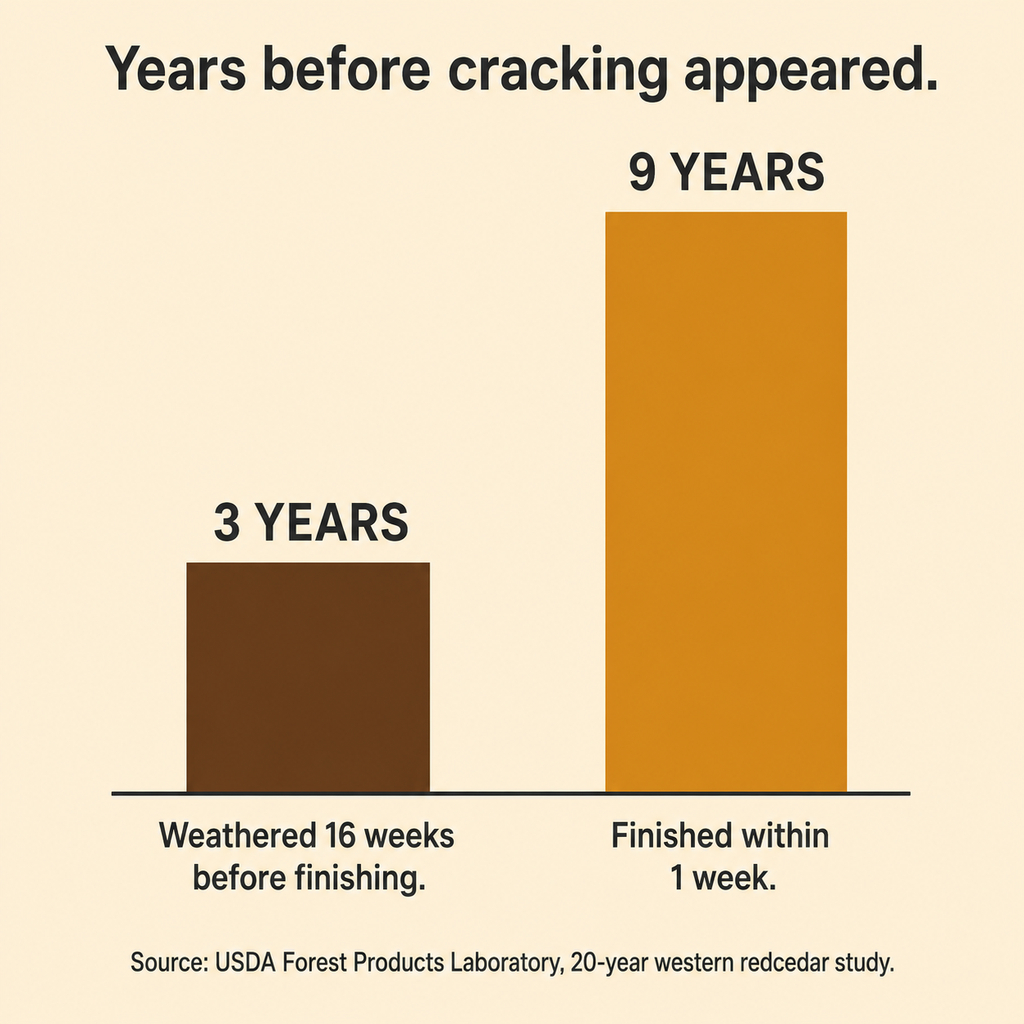
- Prep quality. An FPL 20-year study on western redcedar found that wood preweathered 16 weeks before painting showed cracking after only three years, while wood preweathered zero to one week lasted nine years before cracking.
- Application count and quality. FPL’s Table 16-4 notes that a two-coat paint system (versus the ideal three) cuts service life roughly in half.
Consumer Reports testing found that products with identical lifetime warranties performed very differently in practice, and warranties do not predict actual life.
What the real numbers look like by surface type
Rather than one blanket number, here is what independent testing and FPL data show for semitransparent penetrating stain on different surfaces:
- Horizontal deck surface in full sun: approximately 2 years
- South-facing vertical wall in full sun: 3 to 4 years
- Fences: 4 to 5 years
- Water repellent (clear, no pigment): 6 to 12 months
The spread between a flat deck and a fence is 2 to 3x, on the same product. That is why a single longevity claim is almost always misleading. Sun exposure, foot traffic, and orientation are doing most of the work.
For paint (a film-forming finish), FPL data shows up to 20 years on ideally prepped wood, but that number collapses quickly with poor prep or incompatible substrates. Film finishes can last longer in raw calendar years than penetrating stains. But raw calendar years are not the whole story. What matters just as much is what happens when the finish reaches the end of its life, and how much work the next cycle costs you.
Hybrid and Mislabeled Stain Formulas
Some products sold as oil-based stains behave like film-forming finishes when it comes to failure and removal. Alkyd-acrylic blends (“hybrid” formulas) aim to combine oil’s penetration with acrylic’s cleanup and durability, but results vary widely. Some products labeled as oil stains build up on the surface over multiple applications and eventually require stripping, which is film-forming behavior regardless of what the label says.
The label on the can is not always a reliable indicator. Here is a visual test that is:
If the existing finish looks chalky, dull, and is wearing away evenly, it is behaving as a penetrating finish. You can clean and reapply without stripping.
If the finish is flaking, peeling, or still shiny in patches, treat it as a film-forming finish regardless of what the original label said. You will need to strip it before you can refinish.
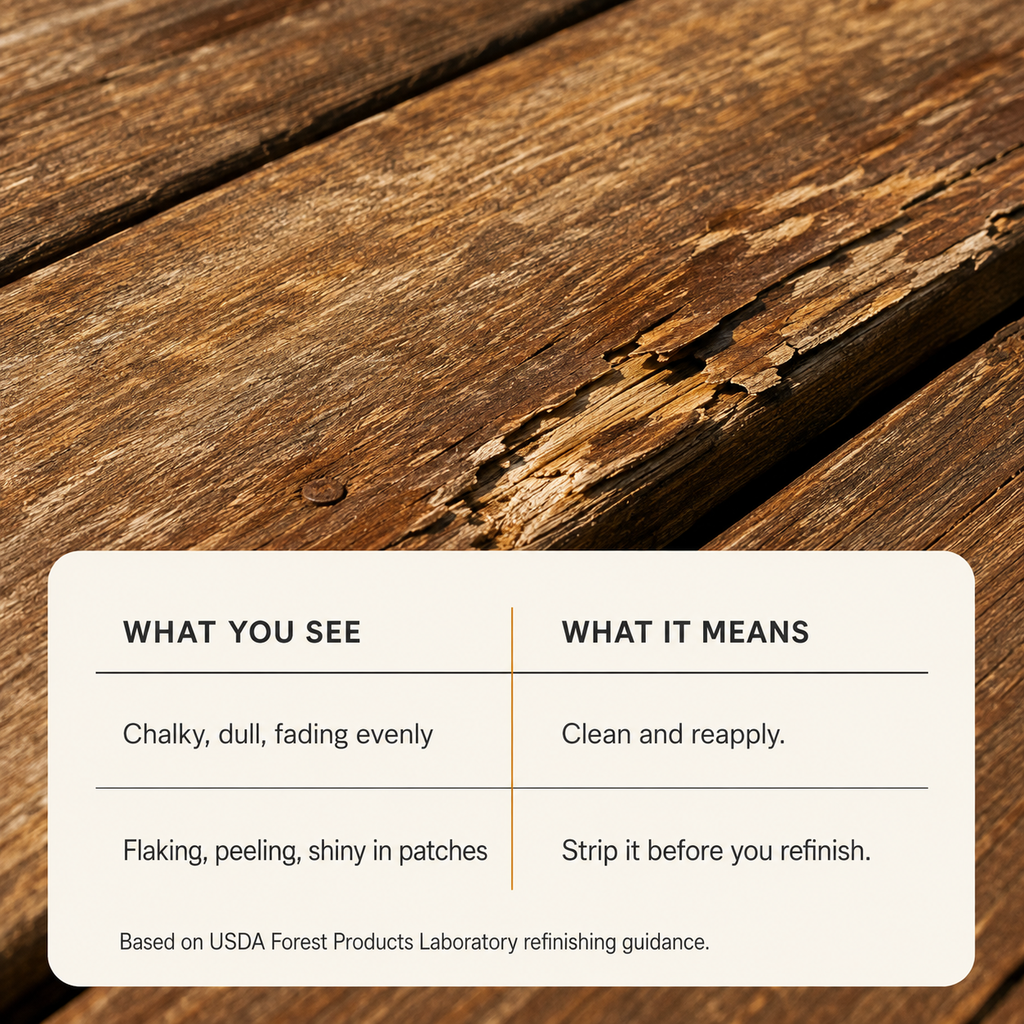
This diagnostic matters because the prep process, not the product you are applying next, is determined by what is already on the wood. We explain this in more detail in our guide to the scratch test and why it matters.
If you are dealing with a finish that is peeling and needs to come off, our HD-80 and Citralic stripping system handles the removal.
VOC, Odor, and Regulatory Compliance
One of the most common assumptions in this comparison is that oil-based stain means high VOC. That is not necessarily true, and the regulatory picture is more specific than most articles make it.
What the actual VOC limits are
VOC limits for exterior wood stains vary by more than 5x depending on where you live:
| Jurisdiction | VOC Limit (g/L) | What It Covers |
| Federal (EPA AIM rule) | 550 | Clear and semitransparent wood stains nationwide |
| California (CARB) | 250 | Exterior and dual-use stains |
| OTC / Northeast Corridor states | 250 | CT, DE, DC, ME, MD, MA, NH, NJ, NY, PA, RI, VT, VA (partial) |
| South Coast AQMD (Southern California) | 100 | Strictest district in the US |
Source: EPA Architectural Coating Rule fact sheet; CARB 2019 Suggested Control Measure; OTC Model Rule.
Low-VOC oil-based stain is real
Oil-based stains can be and are formulated to meet the 250 g/L limit used in California and the Northeast Corridor. The method is straightforward: increase the solids content (pigment, resin, mildewcide) and reduce the solvent. A US patent documents a soy-alkyd penetrating wood stain formulated at 250 g/L, benchmarked against a 550 g/L control.
Our Timber Oil is 100% oil-based and low VOC, compliant in both the Northeast Corridor and California, which both enforce a 250 g/L limit for exterior stains. The assumption that choosing oil means choosing high VOC is outdated for well-formulated products.
That said, there is a practical limit. At the strictest tier (SCAQMD’s 100 g/L), hitting the number with oil is materially harder than with water. In those markets, water-based products are simply easier to find. If you are in the South Coast Air Quality Management District, water-based may be your most practical option.
A note on lifetime VOC
Russell Cissell’s position is that when you count the VOCs involved in stripping and reapplying a failed film-forming product over the life of the wood, an oil-based penetrating finish can produce fewer total VOCs than a water-based one that requires chemical stripping every few years. No published study has quantified this exact comparison. The closest peer-reviewed work (lifecycle assessments of coated wood facades) supports the direction: reapplication frequency and the removal step dominate lifetime coating impacts. But no isolated VOC mass number has been produced. We state Russell’s position here as his position, because we think it is a question worth asking even though no independent study has answered it yet.
Where Water-Based Stain Is the Better Choice
This article focuses on exterior softwood because that is where the penetrating-vs.-film-forming distinction matters most. But water-based finishes have real advantages, and pretending otherwise wouldn’t be fair.
Indoor furniture and cabinetry. Low odor, fast dry time, and soap-and-water cleanup make water-based finishes the practical choice for indoor projects. You are not fighting UV, rain, or freeze-thaw cycles indoors, so the penetration advantage that matters outside is less relevant.
Fast-turnaround projects. Water-based stain can dry to the touch in as little as 30 minutes and allow recoating in 2 to 4 hours. Oil-based typically takes around 4 hours to dry to the touch and 24 to 48 hours between applications. If you are working a tight schedule or a weekend project with a narrow weather window, that difference is real. For more on dry time and recoat window details with oil-based products, we have a dedicated breakdown.
Low-odor requirements. Oil-based stains have a noticeable solvent smell during application. For enclosed or semi-enclosed spaces, or for anyone sensitive to solvent fumes, water-based is more comfortable to work with.
Easy cleanup. Soap and water versus mineral spirits. For a homeowner who does not want to deal with solvent disposal, water-based cleanup is simpler.
The strictest VOC jurisdictions. In SCAQMD territory (parts of Southern California), the 100 g/L limit makes compliant oil-based options scarce. Water-based formulations meet that limit easily.
Solid-color applications. For opaque, solid-color exterior stain work, FPL and the GSA’s historic preservation guidelines recommend acrylic-based products. Oil’s advantages are concentrated in the semitransparent penetrating category.
None of these wins are small. If your project fits any of these categories, water-based is likely the right pick.
Mildew Resistance: What Actually Controls It
Both sides of this comparison make mildew claims, and neither is entirely wrong.
Oil and alkyd resins are a carbon food source for mildew organisms. Former FPL research chemist Bill Feist confirmed that alkyd and oil-based finishes have a greater tendency to grow mildew than acrylic latex finishes, because the resins themselves feed the mildew. Purdue Extension research supports this: finishes containing linseed oil are especially susceptible, and acrylic latex is the most mildew-resistant water-based binder.
That is a legitimate advantage for water-based finishes. But it is not the full picture.
FPL also establishes that mildew spores infect all surfaces, and that any finish (acrylic or oil) eventually supports mildew growth as the mildewcide breaks down. Wood species rich in natural extractives can be more prone to mildew regardless of the finish on top. The mildewcide package, moisture levels, and temperature are the actual control variables, not the base chemistry alone.
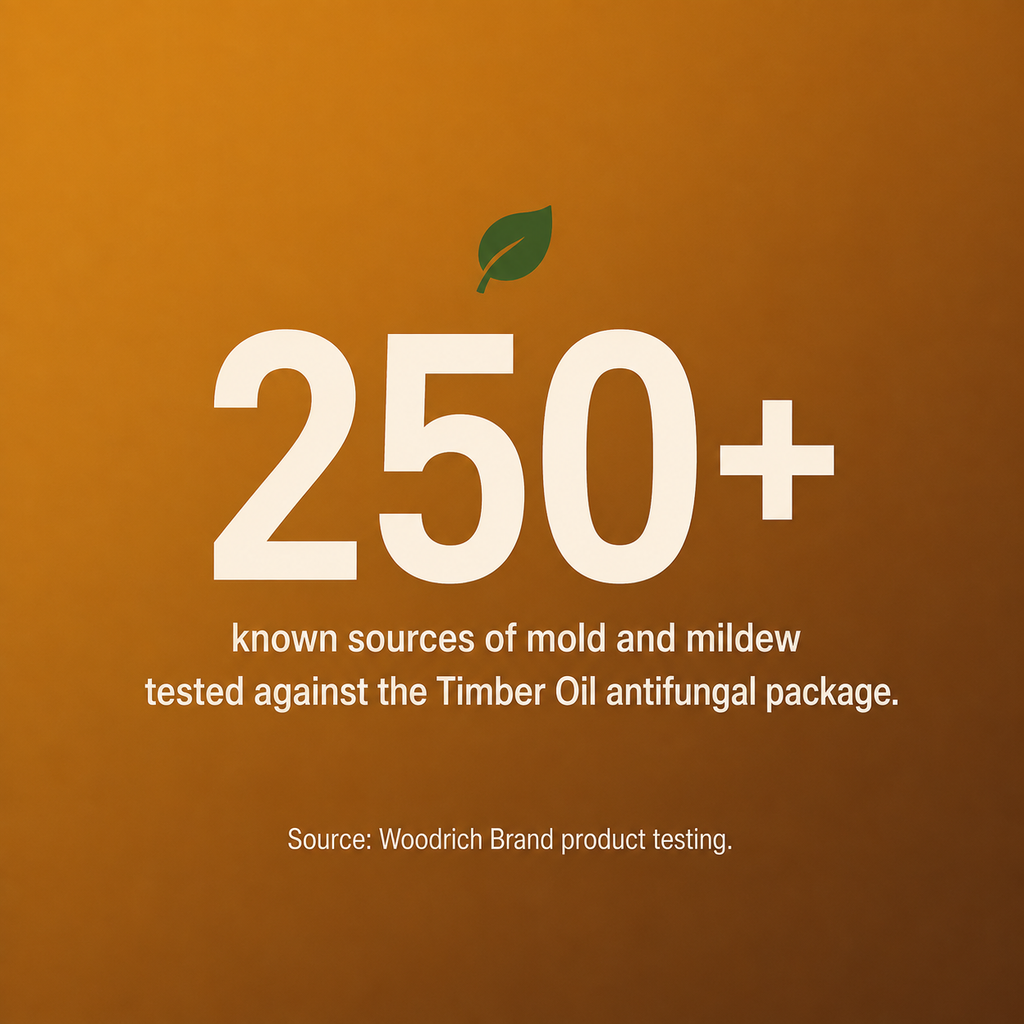
Timber Oil’s antifungal package has been tested against more than 250 known sources of mold and mildew. We invest in the mildewcide formulation specifically because we know oil-based finishes need it. The binder type sets the baseline, but the mildewcide is what governs how long the finish resists mold growth in practice.
What to Know Before Choosing a Stain for Your Deck
For most exterior softwood projects (decks, fences, siding, pergolas, log homes), a penetrating oil-based stain is the stronger long-term choice. The failure mode is forgiving: fading instead of peeling. The refinish process is simple: clean and reapply instead of strip and start over. And over the lifetime of the wood, the total labor and cost of maintenance is lower because you never have to undo a failed film.
For indoor projects, fast-turnaround work, low-odor requirements, or the strictest VOC jurisdictions, water-based has clear advantages that make it the better pick.
There is no stain type that is universally better. The right one depends on your surface, your climate, and how much maintenance work you are willing to take on.
For a closer look at how different finishes compare in terms of opacity and sheen, see our guide to understanding deck stain finishes.
FAQ
Is oil-based stain better than water-based for a deck?
For most exterior decks, yes. Oil-based penetrating stain soaks into the wood rather than forming a surface film, which means it fades gradually instead of cracking and peeling. When it is time to refinish, you clean and reapply rather than stripping the old finish. That difference in maintenance over the life of the deck is the main reason we recommend oil-based for horizontal exterior wood.
How long does oil-based deck stain last compared to water-based?
It depends on the surface. On a horizontal deck in full sun, expect roughly 2 years for a semitransparent penetrating stain. On a south-facing wall, 3 to 4 years. On a fence, 4 to 5 years. Published claims that compare one blanket number against another are comparing products with different pigment loads, different prep quality, and different surface orientations.
Can you put oil-based stain over water-based stain?
Not directly over an intact water-based film. If the water-based stain has formed a film on the surface (which most do), the oil has no exposed wood fiber to penetrate. You need to strip the existing film first, then brighten and neutralize the wood, then apply the oil-based stain to bare wood. If the old finish has already worn away completely and the wood is bare, you can apply oil-based stain after cleaning and brightening.
Does oil-based stain have strong fumes?
Oil-based stain does produce a noticeable solvent odor during application. It dissipates as the stain dries and cures, typically within a few days. For outdoor projects with good air circulation, most homeowners find the odor manageable. For enclosed or semi-enclosed spaces, water-based is more comfortable.
Is oil-based stain high VOC?
Not necessarily. VOC content depends on formulation, not on whether the stain is oil-based or water-based. Timber Oil Deep Penetrating Wood Stain is 100% oil-based and low VOC, compliant in both California and the Northeast Corridor states, which both enforce a 250 g/L limit for exterior stains. Oil-based stains achieve low VOC by increasing solids content and reducing solvent.
How do you tell if an existing stain is oil-based or water-based?
Look at how it is wearing. If the finish looks chalky, dull, and is fading evenly, it is behaving as a penetrating (typically oil-based) finish. If it is flaking, peeling, or still shiny in patches, it is behaving as a film-forming (typically water-based) finish. The visual test matters more than the original label for determining your refinish approach.
Get It Right the First Time
If you are choosing a finish for an exterior softwood deck, fence, or siding project, Timber Oil Deep Penetrating Wood Stain is 100% oil-based with no water, guaranteed not to crack or peel, and covers 150 sq ft per gallon. It comes in six colors, and you can order a sample color kit to test on your actual wood before committing.
If your wood is weathered, gray, or carrying a failed finish, start with our three-step system: clean or strip, brighten and neutralize, then stain.
Not sure what your deck needs? Call or text a photo of your project to our Project Support Hotline at (636) 288-8512. You’ll reach a restoration professional directly, not a call center. We’ll identify what is on your wood and tell you exactly what it needs.